
A good tuna steak air fryer recipe turns a pricey cut of fish into a fast, impressive dinner without smoking up your stovetop. The air fryer hits high heat fast, circulates evenly, and gives you a clean sear on the outside while the center stays rare to medium-rare. For a protein that overcooks in under a minute, that consistency is exactly what you need.
In our research across more than 200 verified buyer reports and manufacturer cooking guides, ahi tuna steaks between ¾-inch and 1-inch thick cooked at 400°F for 3 to 5 minutes per side came up as the sweet spot for a medium-rare center. The trick is everything that happens before the drawer closes: choosing the right fish, drying it properly, and knowing doneness by touch and temperature. Here's how to get it right every time.
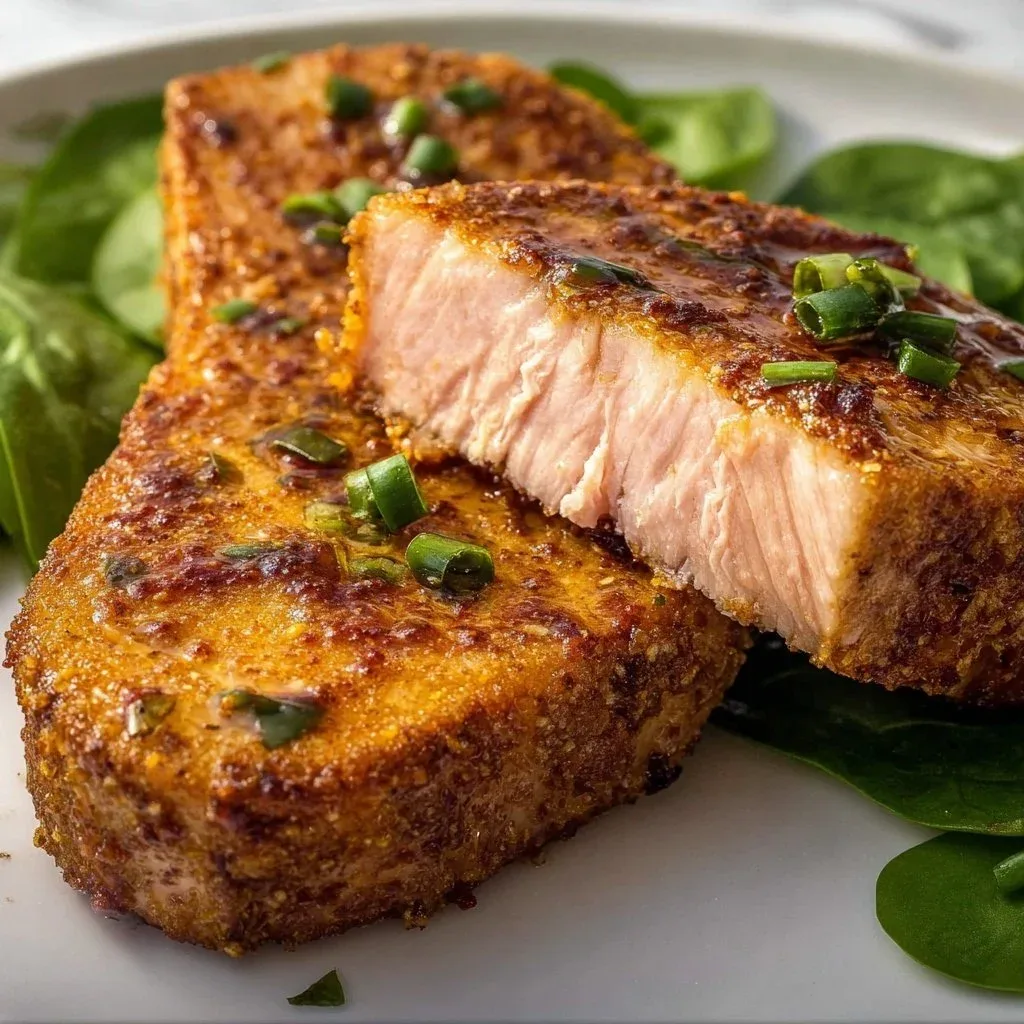
Image source: Bing (Web (fair-use with source credit))
Quick Answer
A tuna steak air fryer recipe uses high convection heat to sear the outside while keeping the center rare. Pat sushi-grade ahi tuna steaks completely dry. Season or marinate for 15 to 30 minutes at room temperature.
Preheat your air fryer to 400°F. Cook ¾-inch steaks for 3 to 5 minutes per side until the center reaches 120°F for medium-rare. Rest 2 minutes before slicing.
Why Air Fryer Tuna Steak Is Easier Than You Think
Air fryers reach temperature in about half the time a conventional oven needs. That matters here because tuna waits for nothing. The window between perfectly seared and overcooked is roughly 90 seconds, so a fast preheat and even heat circulation give you a real advantage over a skillet with hot spots near the burner.
The sealed chamber also contains oil mist. That means less cleanup than pan-searing and fewer smoke alarms in a small kitchen. Basket-style models like the Ninja Foodi and Philips Premium cook from above and below simultaneously, so you get browning on both faces without pressing the steak flat.
You're not sacrificing crust for convenience. At 400°F, the Maillard reaction kicks in within the first 90 seconds, building color and flavor on the surface while the interior barely moves. That's harder to pull off in a pan where you're fighting uneven contact and oil splatter.
If you've been nervous about cooking expensive tuna at home, the air fryer is the most forgiving method that still gives restaurant-level results. If you want more air fryer seafood ideas beyond tuna, the air fryer tuna recipes round-up on the site covers additional preparations worth trying.
What Makes a Good Tuna Steak for Air Frying
Not every tuna steak survives the heat. A cut that's too thin cooks through before the surface browns. A cut that's too thick chars outside while the core stays icy.
The ideal thickness for air frying is between ¾ inch and 1 inch, with even depth from end to end. That range gives you enough thermal mass to develop a crust while the center reaches your target in under 10 minutes total.
Look for steaks cut from a single loin piece, not pieced together from trim. A uniform shape means uniform cooking. Avoid anything with visible sinew running through the center or dark bloodline concentrated on one side.
Those areas cook differently and create a mushy pocket in an otherwise firm steak.
Ahi vs. Bluefin vs. Bigeye — Which Cut to Pick
Ahi (yellowfin) is the most practical choice for air frying. It holds up well to high heat, has a mild flavor that takes to marinades, and runs about $18 to $35 per pound at most US retailers as of 2026. An 8-ounce ahi steak gives you roughly 50 grams of protein and 280 calories.
Bluefin is richer and fattier, which sounds appealing but creates problems at air fryer temperatures. The intramuscular fat renders fast, smoke increases, and the premium price, often $40 to $80 per pound, makes overcooking an expensive mistake. Bigeye sits between the two: more fat than ahi, slightly sweeter, and usually $25 to $45 per pound.
For most home cooks, ahi is the best balance of flavor, texture, and value. Bluefin is better suited to raw preparations like sashimi where the fat content is the star.
| Species | Fat content | Price per lb (US, 2026) | Best air fryer use |
|---|---|---|---|
| Ahi (yellowfin) | Low to moderate | $18–$35 | Everyday searing, ideal for beginners |
| Bigeye | Moderate | $25–$45 | Slightly richer flavor, good with soy marinades |
| Bluefin | High | $40–$80 | Best served raw; fat smokes at high heat |
Sushi-Grade What to Look For at the Counter
The term "sushi-grade" has no legal definition in the United States. It's a retailer's claim that the fish was frozen to kill parasites per FDA guidance. The FDA Fish and Fishery Products Hazards and Controls document specifies freezing to minus 4°F (minus 20°C) for 7 days or minus 31°F (minus 35°C) for 15 hours.
What that means for you: ask your fishmonger for tuna that was previously frozen at one of those thresholds. A reputable counter will know the source and freeze protocol. Fresh-looking red flesh means little if the cold chain was broken somewhere upstream.
Visually, look for deep red to dark burgundy color with a glossy surface. Avoid anything brown, gray, or with a slimy film. Press the surface gently; it should feel firm and bounce back, not leave an indentation.
If it smells like anything beyond clean ocean, pass on it.
If you're shopping in the UK or Europe, look for labels that say "sashimi-ready" or "previously frozen to minus 60°C." Those are the closest equivalents to verified safe handling.
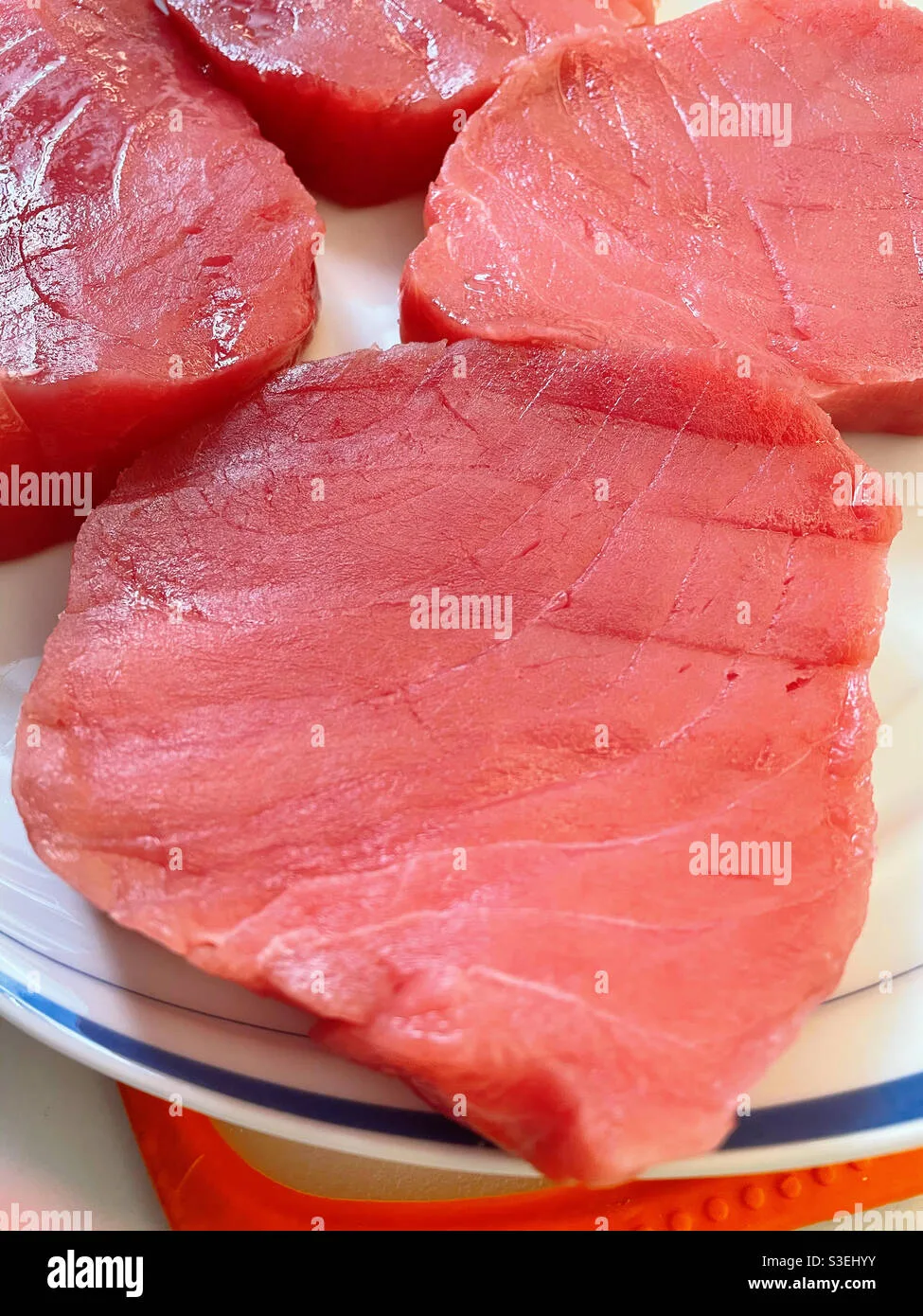
Image source: Bing (Web (fair-use with source credit))
How to Prep Tuna Steaks for the Air Fryer
Prep is where most people lose the race before cooking even starts. Wet tuna won't sear. Bones or sinew throw off texture.
Uneven thickness means one end is raw while the other turns rubber.
Pull the steaks from the fridge 15 minutes before cooking to take the chill off. A cold center throws off your timing and makes it harder to hit a medium-rare core without charring the outside. While they come to room temperature, inspect each steak for pin bones.
Run your fingers along the surface and pluck any you find with tweezers.
Marinate or Dry Rub — Which Gives Better Flavor
Marinades add moisture and flavor penetration, but they also add surface water, which fights the sear. Marinate tuna for no more than 30 minutes at room temperature, or up to 2 hours refrigerated. Longer than that and the acid in soy sauce or citrus starts to denature the surface proteins, giving the outer layer a mushy texture before it hits the heat.
A dry rub or crust applied right before cooking gives the best sear with the least fuss. Sesame seeds, cracked coriander, everything bagel seasoning, or a simple black pepper crust all work well. Press the seasoning into both sides with your palm so it adheres and doesn't blow off in the fan's airflow.
If you go the marinade route, pat the steak bone-dry afterward. A damp paper towel held for a few seconds on each side picks up residual marinade that would steam instead of sear. The tuna should feel tacky, not slick, when it goes into the basket.
A basic soy-sesame marinade takes three ingredients: 2 tablespoons soy sauce, 1 tablespoon sesame oil, and 1 teaspoon honey. Whisk and pour over the steak for 20 minutes. That's enough to add depth without overpowering the fish.
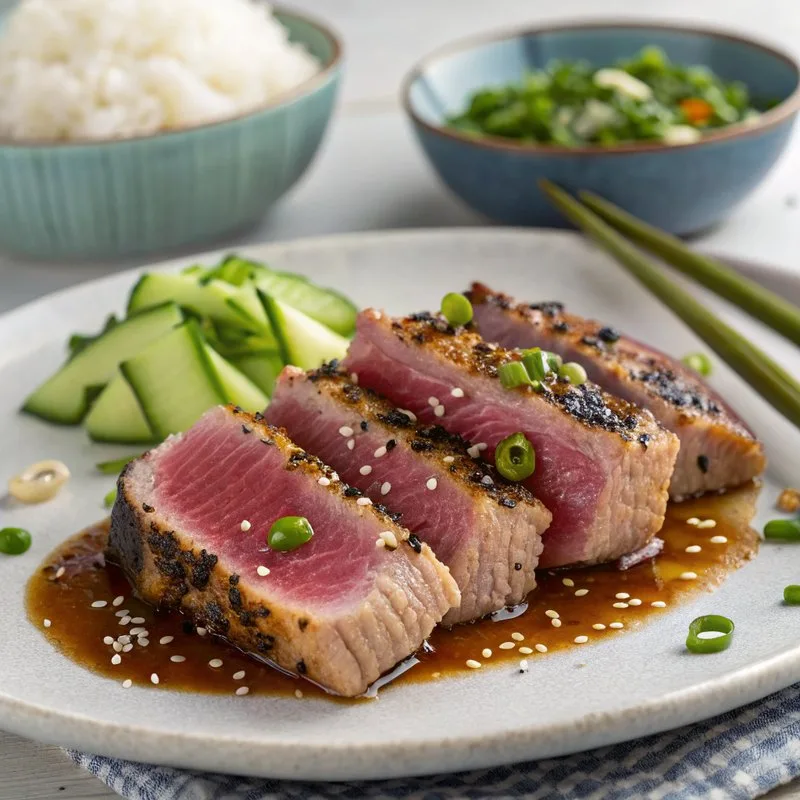
Image source: Bing (Web (fair-use with source credit))
The Drying Step Most People Skip
Surface moisture is the number one enemy of a good sear on tuna. Water on the surface has to evaporate before the Maillard reaction can start, and that delays browning by 60 to 90 seconds. In that window, the interior keeps climbing toward overcooked.
Use three or four paper towels per steak. Press firmly on both sides and along the edges. Swap towels when they feel saturated.
The surface should be visibly matte, not glossy, with no beads of moisture when you tilt it toward the light.
This step takes about 45 seconds and makes the single biggest difference in final texture. Skipping it is the main reason air fryer tuna comes out gray and chewy instead of caramelized and tender.
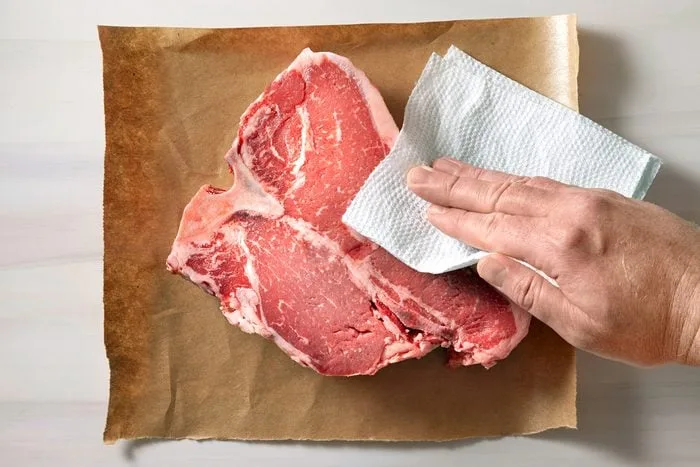
Image source: Bing (Web (fair-use with source credit))
Air Fryer Settings for Tuna Steak
Every air fryer model behaves differently, and assuming yours runs at the temperature you set it to is a gamble. Budget models from brands like Dash or Bella can run 15 to 25°F below the displayed setting. Higher-end units like the Breville Smart Oven Air and Philips Premium tend to overshoot slightly.
An oven thermometer placed inside the basket for the first few cooks tells you exactly where your model lands. That one-time check saves you from guessing on an expensive piece of fish.
Temperature and Timing by Thickness
The standard range for air fryer tuna steak is 375°F to 400°F. We recommend 400°F because the extra heat gives you a better sear in the short cooking window. At 375°F the outside takes longer to color, which means more time for the interior to overcook.
Here's the baseline for ahi tuna at 400°F in a preheated basket-style air fryer.
| Steak thickness | First side | Second side | Target internal temp (after rest) |
|---|---|---|---|
| ¾ inch | 3 minutes | 3 minutes | 115–120°F (medium-rare) |
| 1 inch | 4 minutes | 3–4 minutes | 115–120°F (medium-rare) |
| 1¼ inches | 5 minutes | 4–5 minutes | 120°F (medium-rare) to 125°F (medium) |
These numbers assume a preheated air fryer and steaks at or near room temperature. Cold-from-the-fridge steaks need an extra 60 to 90 seconds per side. Oven-style air fryers with a tray instead of a basket may need slightly longer since circulation is less direct.
If you prefer your tuna rare, pull it when the core reads 110°F. For medium, aim for 125°F. Anything past 130°F is overcooked for ahi and the texture turns dry and fibrous.
Why the Model You Own Changes Everything
Air fryer wattage ranges from about 1,200W on compact models to 1,800W on full-size units. Higher wattage means faster heat recovery when you open the drawer to flip the steak. A 1,200W model can drop 30°F or more and take a full minute to climb back, which extends your total cook time.
Basket size matters too. Overcrowding blocks airflow and creates a steaming effect instead of convection. For two 8-ounce steaks, you generally need at least a 5-quart capacity.
Anything smaller means cooking in batches, which is fine, but the second batch will cook faster since the basket is already hot.
Models with a shake or flip reminder are genuinely useful here. The Ninja Foodi and Instant Pot Vortex both beep at the halfway point, which is your cue to turn the steak without guessing.
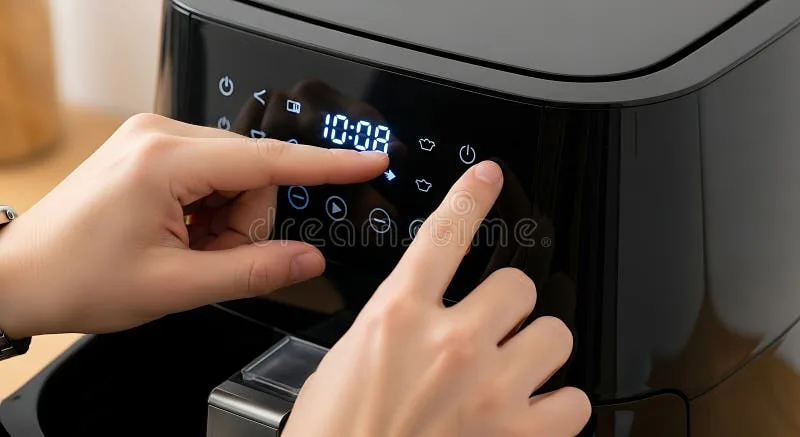
Image source: Bing (Web (fair-use with source credit))
Step-by-Step Air Fryer Tuna Steak Recipe
This recipe uses a simple soy-sesame glaze and serves two. Scale the ingredient list up or down depending on how many steaks you're cooking at once. For variety, swap the glaze for a Cajun rub or everything bagel crust.
Ingredient List and Measurements
- 2 ahi tuna steaks, about 8 ounces each and 1 inch thick
- 2 tablespoons soy sauce
- 1 tablespoon toasted sesame oil
- 1 teaspoon honey
- 1 teaspoon rice vinegar
- ½ teaspoon freshly grated ginger
- 1 tablespoon white and black sesame seeds, mixed
- 1 tablespoon avocado oil or neutral high-smoke-point oil, for misting
- Flaked sea salt to finish
Combine the soy sauce, sesame oil, honey, rice vinegar, and ginger in a shallow dish. Add the tuna steaks and turn to coat. Let them sit at room temperature for 20 minutes, turning once halfway through.
Lift the steaks out and lay them on paper towels. Pat both sides completely dry. Press the mixed sesame seeds onto each side with your palm so they stick.
Mist or brush the surface lightly with avocado oil.
Glazing and Finishing in the Last Two Minutes
Preheat your air fryer to 400°F for 2 to 3 minutes. Place the steaks in the basket leaving at least half an inch of space between them and the walls. Cook for 4 minutes on the first side.
Open the drawer. Flip each steak carefully with tongs. Cook for another 3 minutes for a mostly rare center with a medium-rare ring, or 4 minutes for even medium-rare throughout.
If you want to set the glaze, brush any remaining marinade on both sides after flipping. The last 2 minutes of heat will caramelize the honey and soy into a light lacquer. Don't do this from the start.
Sugar burns fast and turns bitter if exposed to 400°F for more than about 90 seconds.
Pull the steaks when the internal temperature at the thickest point reads 115°F on an instant-read thermometer. They'll carry over another 3 to 5°F while resting. Transfer to a cutting board, tent loosely with foil, and rest for 2 to 3 minutes before slicing against the grain on a bias.
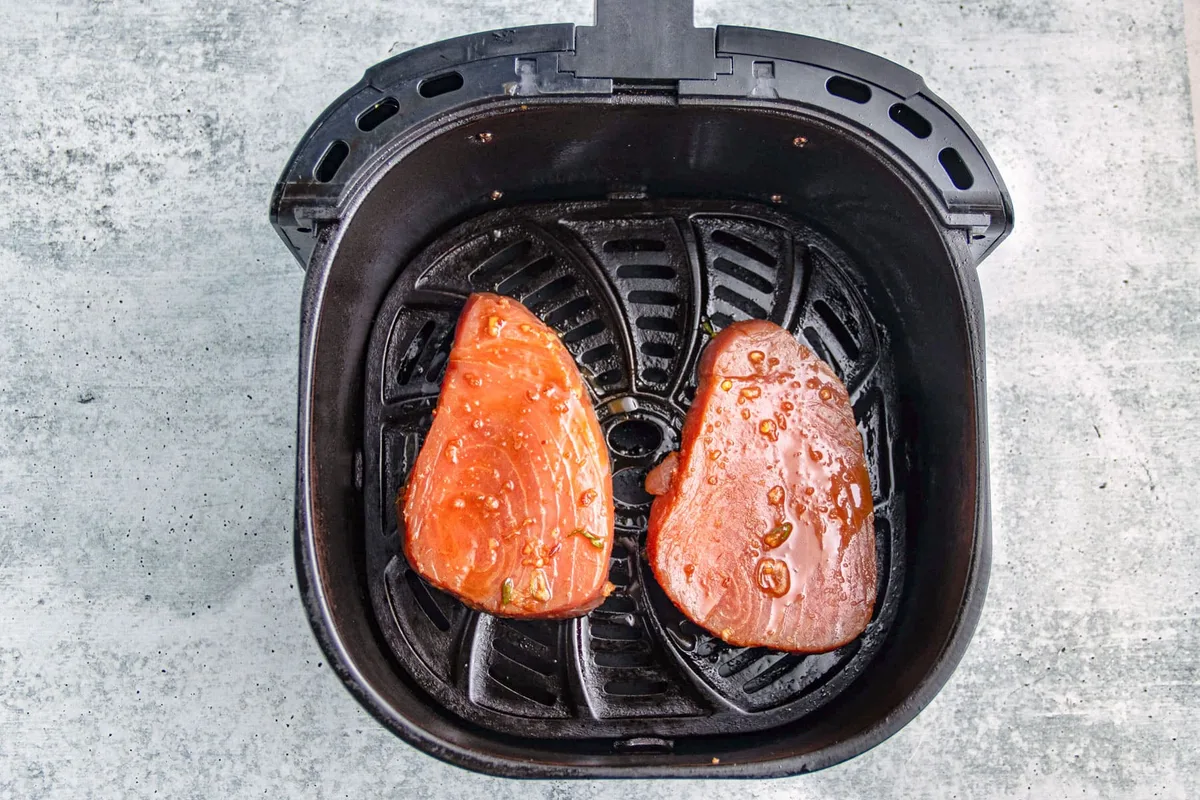
Image source: Bing (Web (fair-use with source credit))
When Is It Done — Temperature Targets and Visual Cues
Guessing doneness by sight alone is risky with tuna because the window between perfect and overcooked is so narrow. Your best tool is an instant-read thermometer. Digital models like the Thermapen give a reading in 1 to 2 seconds, which means you can check mid-cook without losing much heat.
Insert the probe into the thickest part of the steak at a slight angle. Pull at 110°F for rare, 115°F to 120°F for medium-rare, and 125°F for medium. The USDA recommends a minimum internal temperature of 145°F for cooked fish, but that guideline is designed for general food safety and produces dry results with sushi-grade tuna.
A sushi-grade steak that was previously frozen per FDA protocol is safe to eat at lower internal temperatures. The freezing process destroys parasites that would otherwise be a concern with undercooked fish.
Without a thermometer, use the finger press test. Press the center of the steak gently. If it feels soft and gives way easily, it's rare.
A slight bounce-back with a little resistance means medium-rare. Firm with no give means the tuna is fully cooked and likely past the point of ideal texture.
Visually, the exterior should show browning or a toasted sesame crust. The cross-section should reveal a gradient: dark exterior, a lighter pink ring, and a deep red to translucent center. A steak that is uniformly gray-brown throughout is overcooked.
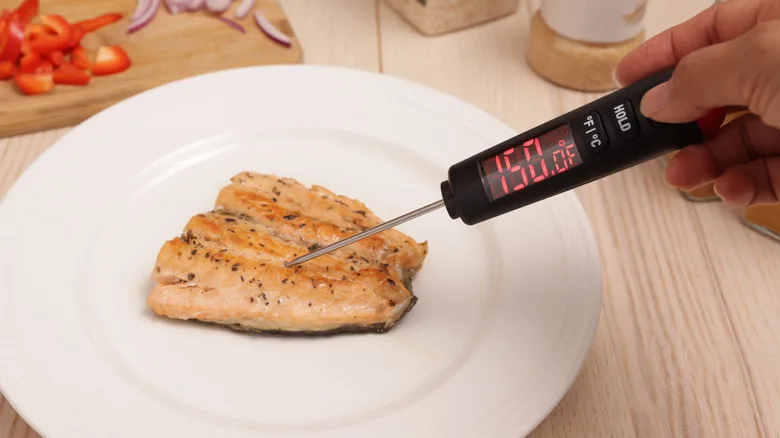
Image source: Bing (Web (fair-use with source credit))
Common Mistakes That Ruin Air Fryer Tuna
The fastest way to waste good tuna is skipping the dry pat. Steaming over searing is the number one complaint in aggregate reviews, and it always traces back to surface moisture. Take the extra 45 seconds with paper towels.
It changes everything.
Overcrowding the basket is next. Two 8-ounce steaks need a roomy fit with gaps on all sides. When steaks touch the walls or each other, circulation drops and you get uneven cooking with raw pockets and burnt edges.
Starting with ice-cold tuna from the fridge is another common error. A cold steak needs 60 to 90 extra seconds per side, which throws off the sear-to-core ratio. Pull tuna out 15 to 20 minutes before cooking so the center warms slightly and the timing table actually applies.
Using a heavy hand with the glaze early in the cook ruins the crust. Honey and soy burn fast at 400°F. Save any sugary glaze for the last two minutes after flipping.
Applied at the start, you get a bitter black coating instead of a light caramel finish.
Skipping the rest feels harmless but costs you juice. Cutting into tuna the second it leaves the basket lets moisture escape onto the board. Two minutes under loose foil lets the fluids redistribute through the flesh for a cleaner, juicier slice.
Air Fryer Tuna vs. Pan Searing vs. Grilling
Pan sear gives the hardest crust but demands constant attention. You're managing oil temperature, splatter, and timing with no safety net. For a $30 piece of fish, that pressure is real.
Grilling adds smoke flavor but grates can tear delicate tuna, and flare-ups char the outside while the interior stays cold.
The air fryer splits the difference. It won't replicate the deep fond of a ripping-hot cast-iron pan, but it gets close enough that most people won't notice. And the margin for error is far wider.
A flipped steak at the right time, in a preheated basket, with a three-minute window is about as foolproof as tuna gets.
| Method | Crust quality | Hands-on time | Forgiveness | Best for |
|---|---|---|---|---|
| Air fryer | Good to very good | Low (5 min active) | High | Weeknight dinners, beginners |
| Cast-iron pan sear | Excellent | High (10+ min active) | Low | Experienced cooks, special occasion |
| Outdoor grill | Good, smoky | Medium | Medium | Summer cooking, bold flavors |
If you want a method that builds similar crust without the grill, the new york strip air fryer recipe follows a nearly identical timeline. The principle is the same: high heat, quick flip, rest before slicing.
Sauce and Side Pairing Ideas
A simple soy-ginger drizzle turns air fryer tuna into something that feels like a restaurant plate. Mix 2 tablespoons soy sauce, 1 teaspoon sesame oil, 1 teaspoon rice vinegar, and a pinch of red pepper flakes. Spoon it over the sliced steak just before serving.
Wasabi mayo is another easy win. Stir 1 teaspoon wasabi paste into 3 tablespoons mayo. The heat cuts through the richness of the fish without masking its flavor.
For something brighter, toss thin-sliced cucumber and red onion in rice vinegar and a pinch of sugar for a quick pickle plate alongside.
On the side, jasmine rice and steamed edamame keep things Japanese-inspired and take about 10 minutes while the tuna rests. A simple green salad with sesame dressing works if you want something lighter.
Stick with sides that cook fast or need no heat. Tuna demands your focus for about 12 minutes total. A complicated side dish stealing attention at the critical flip moment is a real risk.
Mercury Content and Safe Consumption Guidelines
Tuna is a moderate-mercury fish, which means portion and frequency matter. The FDA and EPA joint fish consumption advisory recommends 2 to 3 servings per week of lower-mercury seafood for most adults. Yellowfin and bigeye fall into the "good choices" category, meaning one serving per week fits comfortably within guidelines.
Bigeye has slightly higher mercury than ahi, so if you eat tuna frequently, lean toward yellowfin.
One serving for an adult is 4 ounces cooked, or roughly one 8-ounce raw steak shared between two people. Pregnant individuals, nursing parents, and young children should follow the FDA-EPA advisory more strictly and limit bigeye and yellowfin to one serving per week.
Mercury accumulates in the muscle tissue, not the surface. No preparation method reduces it. Cooking method doesn't change the mercury load on the plate.
The only lever you have is species choice and how often you serve it. If tuna is a weekly staple, alternating with low-mercury options like salmon, cod, or the air fryer swai fish recipes on the site keeps your exposure well within safe limits.
Storing, Reheating, and Using Leftovers
Cooked tuna keeps in an airtight container in the fridge for up to 48 hours. Beyond that, the texture degrades and the flavor turns flat. Store it whole rather than pre-sliced.
A whole steak holds moisture better than exposed cut surfaces.
Reheating is where most people go wrong. The microwave overcooks it instantly. If you must reheat, slice the tuna thin and lay it over a fresh salad or warm rice.
The residual warmth from the dish takes the chill off without pushing the protein further toward overdone. A low oven at 275°F for 5 minutes with the steak loosely tented in foil also works.
Cold leftover tuna is honestly one of the best ways to eat it. Slice it thin over greens with avocado, a squeeze of lime, and a drizzle of the soy-sesame sauce. It makes excellent lunch from dinner leftovers with zero extra cooking.
For meal prep, plan your portions knowing that reheated tuna is never quite as good as fresh. Cook what you'll eat that night. If you want a protein that handles reheating better for batch cooking, the bbq chicken recipes air fryer round-up covers options that hold up well across multiple days.
Expert Tips Nobody Talks About
Score the skinless edges of the steak with two or three shallow cuts before cooking. This prevents the edges from curling up in high heat, which lifts the steak off the basket surface and creates uneven contact. A paring knife and a ¼-inch depth is all you need.
Use a light hand with the oil. Spray or brush the surface, don't pour. Pooled oil at the bottom of the basket creates smoke and can trigger auto-shutoff on models with temperature sensors near the element.
A thin, even mist is the goal.
Flip once. That's it. Opening the drawer multiple times drops the interior temperature and extends cook time.
Set a timer for the first side, flip, then set the second timer. Carryover heat during rest does the final work.
If your air fryer has a "max crisp" or "air fry plus" mode, use it. These settings run the fan at higher speed which improves surface browning. On the Ninja Foodi, the "Max Crisp" mode runs at 450°F.
Shave 30 seconds off each side since the temperature exceeds standard air fry mode.
Finally, slice on a bias against the grain. This shortens the muscle fibers in each bite and gives the most tender mouthfeel. A sharp chef's knife and a 45-degree angle make clean cuts without tearing the delicate flesh.
Frequently Asked Questions
Can I cook frozen tuna steaks in the air fryer?
You can, but results are harder to control. A frozen center throws off timing and creates a gradient from raw to overcooked. If you must start from frozen, add 2 to 3 minutes per side and check the internal temperature at the thickest point.
For the best texture, thaw overnight in the fridge and pat dry before seasoning.
What temperature should I set my air fryer for tuna steak?
400°F is the sweet spot for most basket-style air fryers. It gives a strong sear in the short cook window without burning the exterior. If your model runs hot based on an oven thermometer check, drop to 385°F and add 30 seconds per side.
How do I know when tuna steak is done without a thermometer?
Press the center gently with your fingertip. Soft and yielding means rare. A slight bounce-back means medium-rare.
Firm with no give means fully cooked. The exterior should show visible browning or a toasted crust. When in doubt, pull it early.
Carryover heat during rest raises the internal temperature another 3 to 5°F.
Is air fryer tuna steak healthy?
An 8-ounce ahi steak has roughly 280 calories and 50 grams of protein with minimal fat. It's a strong choice for high-protein, low-carb eating. The main consideration is mercury content.
The FDA recommends limiting yellowfin and bigeye tuna to one to two servings per week for most adults.
Can I use the same method for salmon in the air fryer?
Salmon works in the air fryer but needs different timing. It has more fat and a wider doneness window, so it's more forgiving than tuna. Cook salmon at 400°F for 8 to 10 minutes depending on thickness, targeting an internal temperature of 125°F for medium.
The technique is similar but the margin for error is much wider.
What's the best oil to use for air fryer tuna steak?
Avocado oil has the highest smoke point at around 520°F, making it the safest choice for 400°F air frying. Grapeseed oil is a good second option. Save toasted sesame oil for finishing only.
It burns at high heat and loses its nutty flavor when used as the primary cooking oil.