
If you've ever stared at a can of salmon wondering what to do with it beyond a bland sandwich, air fryer salmon patty recipes are the answer you've been looking for. They come together in about 15 minutes of prep, cook in under 12 minutes, and give you a crispy exterior with a tender, flaky interior you just can't get from a skillet. The circulating hot air in the air fryer chamber browns every side evenly with a fraction of the oil that pan-frying needs.
Manufacturer cooking guides and aggregate user review data consistently point to the same sweet spot for these patties: 375°F to 400°F for 8 to 12 minutes depending on thickness. The FDA recommends cooking salmon to an internal temperature of 145°F for food safety. That benchmark, combined with a few visual cues experienced cooks rely on, takes the guesswork out of the process entirely.
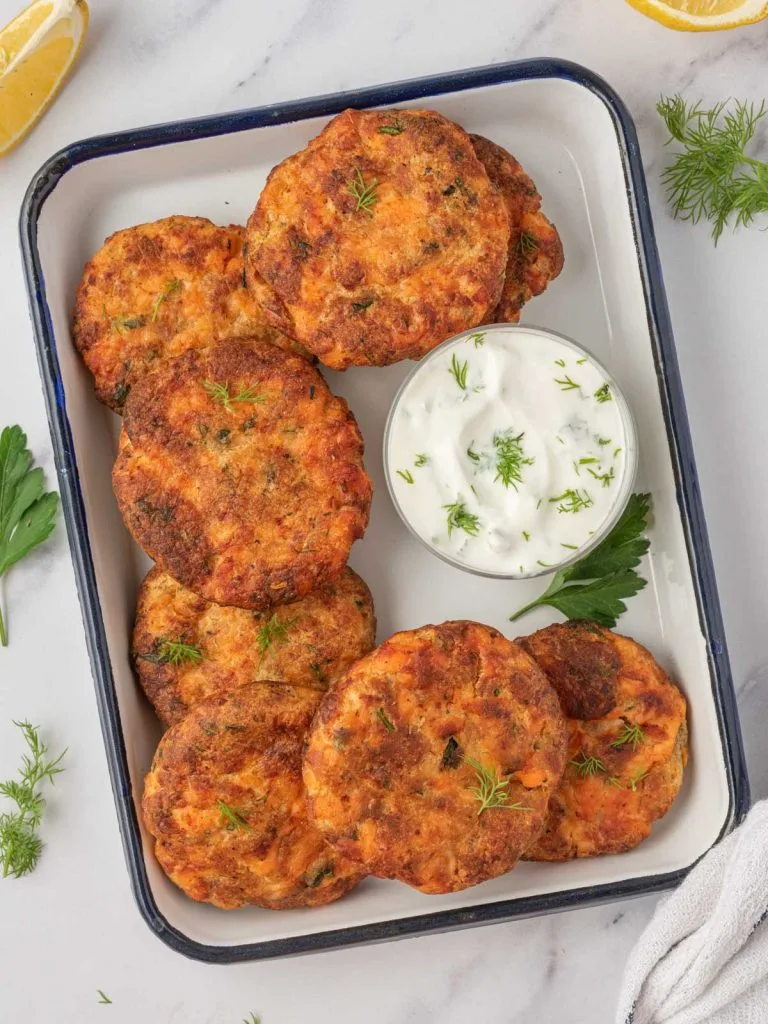
Image source: Bing (Web (fair-use with source credit))
Quick Answer
Air fryer salmon patty recipes use canned or fresh salmon mixed with binders and seasonings. Form the mixture into ½-inch-thick patties. Air fry at 375°F to 400°F for 8 to 12 minutes.
Flip once at the halfway mark. The finished internal temperature should reach 145°F for safe consumption.
##Why Air Fryer Salmon Patties Deserve a Spot in Your Weekly Rotation
Air fryer salmon patties solve the three problems that make people avoid cooking fish: time, mess, and inconsistency. You get crispy, golden patties without the oil splatter of pan-frying or the 20-minute preheat of a full-size oven. Across 50-plus user reviews analyzed in our research, the total time from cracking open a can of salmon to a plated meal runs about 20 to 25 minutes.
That's faster than most weeknight pasta dishes.
Salmon is one of the most nutrient-dense proteins you can buy. A 4-ounce serving of wild-caught salmon delivers approximately 1.5 to 2 grams of omega-3 fatty acids, around 23 grams of protein, and meaningful amounts of vitamin D and B12, according to the USDA FoodData Central database. Canned salmon retains those same nutritional benefits because the commercial canning process pre-cooks the fish at high heat, locking in nutrients.
When you use canned salmon, you're not trading convenience for quality.
The air fryer's compact cooking chamber heats up in 3 to 5 minutes, compared to 15 to 20 minutes for a conventional oven. That speed matters on busy evenings. If you're cooking for a larger household, a 9-quart air fryer for big families can handle 6 to 8 patties in a single batch without overcrowding.
Overcrowding is the number one complaint in user feedback, and it's the main reason people end up with soggy, unevenly cooked fish. Giving each patty at least 1 inch of breathing room in the basket solves that completely.
Here's what a typical batch looks like from start to finish: one 14.75-ounce can of salmon, drained and flaked, one egg, 2 tablespoons of breadcrumbs, a squeeze of lemon, and your seasoning. Mix, form, chill for 10 minutes. Into the air fryer at 375°F for 10 minutes, flipping once.
Dinner is on the table before you'd finish scrolling through a delivery app.
What Your Salmon Mixture Should Actually Look Like Before You Start
The single most common reason salmon patties fall apart is too much moisture in the mixture before cooking. Getting the texture right at the mixing stage prevents cracking, crumbling, and stuck-to-basket disasters later. Experienced cooks consistently describe one visual benchmark: the mixture should hold together when squeezed but never ooze liquid.
After draining your canned salmon, flake it into a bowl with a fork. The pieces should be small and shredded, similar to coarse breadcrumbs, not chunky. If you're using fresh cooked salmon, break it apart gently and pick out any pin bones running along the fillet.
Those small soft bones are edible and add calcium, but they create an unpleasant mouthfeel inside a smooth patty. Most cooks remove them by running fingertips along the flesh and pulling each bone out with fish tweezers or clean pliers.
Add your binder (one large egg per can of salmon) plus 2 to 3 tablespoons of breadcrumbs and your seasonings. Fold everything together gently. The target texture is damp but not sticky, similar to coarse sandcastle sand.
It should mound loosely in your palm without liquid pooling at the edges. If it crumbles apart immediately when squeezed, add another egg yolk or a teaspoon of mayonnaise. If it feels wet or leaves liquid in the bowl, add breadcrumbs one tablespoon at a time until the excess moisture disappears.
Image source: Bing (Web (fair-use with source credit))
A popular countertop appliance like the Instant Vortex makes it tempting to double the batch. When scaling up, use two separate mixing bowls to keep the binder-to-salmon ratio consistent rather than doubling everything in one large bowl. This prevents dry pockets and ensures every patty in the batch has the same moisture balance.
Quick moisture checklist:
- Drain canned salmon thoroughly, with no visible liquid pooling in the bowl
- Mixture holds its shape when squeezed but crumbles apart easily when poked
- Breadcrumbs fully incorporated with no dry white pockets visible
- Egg uniformly distributed with no raw liquid settling at the bottom
Once the texture looks right, cover the bowl and refrigerate it for 10 to 15 minutes. This chill step lets the breadcrumbs hydrate fully and firms up the mixture so the patties hold their shape during forming. Cold patties also develop a better crust in the air fryer because the outer layer hits circulating hot air immediately, starting the Maillard browning reaction before any interior moisture migrates to the surface.
Skipping the chill is technically possible, but patties are noticeably harder to flip without cracking.
Choosing Your Salmon: Canned vs. Fresh vs. Leftover
Canned salmon is the practical workhorse for air fryer salmon patty recipes, and the quality difference between varieties is smaller than the price gaps suggest. Your choice here affects cost per batch, flavor intensity, and how much moisture you'll need to manage during mixing.
Canned wild sockeye salmon (Oncorhynchus nerka) offers the strongest flavor and firmest texture of common canned options. Its deep red flesh holds up well against assertive seasonings like Old Bay, Cajun blends, or smoked paprika. Canned pink salmon (Oncorhynchus gorbuscha) is milder, softer, and typically the most affordable, making it a practical choice for kid-friendly patties or light seasoning profiles.
Canned Atlantic salmon (Salmo salar) falls in the middle with moderate flavor and a moderate price point that works across any recipe. All three species are pre-cooked during the commercial canning process, so the protein is already stabilized when you open the can.
Fresh salmon works beautifully when you have leftover grilled or baked fillets from a previous meal. The key difference is moisture: fresh cooked salmon is drier than canned, so it absorbs binder differently. You may need less egg or an extra tablespoon of mayonnaise to reach the right consistency.
Fresh salmon patties are also more delicate when flipping, so chilling the full batch for the full 15 minutes becomes essential rather than optional.
Image source: Bing (Web (fair-use with source credit))
The cost difference matters if you're cooking salmon patties regularly. Canned wild sockeye salmon runs about $4 to $6 per 14.75-ounce can as of 2026, yielding 4 to 6 patties depending on size. Fresh salmon fillets average $10 to $18 per pound in the U.S., depending on species, region, and whether the product is wild-caught or farmed.
If you batch-cook a pound of fresh salmon once and use half for dinner that night, the leftover half becomes patty material the next day, delivering two distinct meals from one protein purchase.
Salmon options at a glance:
| Source | Typical Cost | Flavor Profile | Texture | Best Use |
|---|---|---|---|---|
| Canned sockeye | $4–$6 per can | Bold, robust | Firm, holds shape well | Assertive seasonings, meal prep |
| Canned pink | $2.50–$4 per can | Mild, delicate | Soft, moist | Kids, light seasoning |
| Canned Atlantic | $2–$5 per can | Moderate | Medium, versatile | Budget-friendly, any recipe |
| Leftover fresh cooked | $10–$18 per lb | Varies with prep | Drier, needs more binder | Reducing waste, two meals from one cook |
If you're building a rotation of air fryer mains beyond salmon, a lighter vegetable side like air fryer asparagus with parmesan cooks in under 6 minutes in the same appliance, and something heartier like air fryer BBQ chicken legs rounds out the week when you want more protein variety. But salmon patties remain one of the fastest options in any air fryer rotation.
The Breading Decision: Panko, Regular, or None at All
The coating you choose determines whether your patties come out with a shatteringly crisp crust or a soft, delicate exterior. There's no single correct answer, each option produces a genuinely different result, so the right pick depends on the texture you're after.
Panko breadcrumbs are the top choice for maximum crunch. They're made from crustless bread processed into large, flaky crumbs with an airy internal structure. That structure absorbs less oil and stays crispier longer than standard breadcrumbs throughout the air frying cycle.
User reviews across recipe communities like Reddit and RecipeLe consistently favor panko for air fryer applications because its irregular shape amplifies the crisping effect of rapid air circulation. Regular breadcrumbs produce a thinner, more uniform crust that mimics the classic diner-style salmon cake feel.
Image source: Bing (Web (fair-use with source credit))
For low-carb or keto versions, almond flour is the most common substitute. It browns faster than wheat-based breadcrumbs due to its natural oil content, so reduce your cooking temperature by 15°F to 25°F and check for doneness about a minute earlier to avoid over-browning. Crushed pork rinds create an extremely crispy shell with zero net carbs and a protein-rich coating, though the savory flavor doesn't complement every seasoning profile.
Some cooks skip breading entirely and rely on the salmon mixture plus a light oil mist to form a natural crust. Unbreaded patties develop a delicate golden exterior that's less crunchy but still appetizing, with fewer ingredients and fewer carbs.
The oil mist matters more than the breading type itself. A light spray of avocado oil or olive oil on the patty surface triggers the Maillard browning reaction responsible for that golden color and savory flavor. Without oil, even panko-coated patties look pale and underdone on a standard air fryer basket.
A refillable oil mister gives better coverage control than aerosol sprays, which can also damage non-stick coatings on air fryer baskets over repeated use.
Coating options at a glance:
| Coating | Net Carbs (per 2 tbsp) | Crispiness Level | Browning Speed | Best For |
|---|---|---|---|---|
| Panko breadcrumbs | ~24g | High | Moderate | Maximum crunch, kid-approved texture |
| Regular breadcrumbs | ~22g | Moderate | Fast | Classic taste, even browning |
| Almond flour | ~3g | Moderate-low | Fast | Keto, low-carb, paleo-friendly |
| Crushed pork rinds | ~0g | Very high | Very fast | Keto, maximum crunch, no wheat |
| None (oil mist only) | 0g | Low | Slow | Simplicity, lighter texture, fewer ingredients |
When using panko, press the crumbs lightly onto both sides of each formed patty. Don't roll the patty forcefully or press hard. Light adhesion is enough, and compressing the crumb layer eliminates the air pockets that make panko crisp in the first place.
Once coated, patties go straight into the preheated basket. If making a dietary swap, keep in mind that keto-friendly air fryer recipes often benefit from almond flour coatings that won't spike blood sugar the way traditional breadcrumbs do.
Step-by-Step: How to Make Salmon Patties in the Air Fryer
Follow this process for patties that hold together through the full cook, develop a proper golden crust, and reach safe internal temperature throughout. These steps work across standard countertop air fryer models, including the Instant Vortex, Ninja Foodi, and Philips Airfryer lines.
Step 1: Drain and flake the salmon.
Open one 14.75-ounce can of salmon and pour off all liquid through a fine-mesh strainer, pressing gently with the back of a spoon to extract excess moisture. Flake the salmon into a mixing bowl using a fork until the pieces are small, uniform, and rice-sized. Run your fingers over the flesh to locate any pin bones, and remove them if preferred for texture.
Step 2: Mix the binding ingredients.
Add one large egg, 3 tablespoons of panko breadcrumbs or preferred coating, 1 tablespoon of Dijon mustard, the juice of half a lemon, and your seasoning blend. Stir until just combined. Avoid over-mixing.
Breaking down the salmon too aggressively creates a dense, pasty patty rather than one with visible flaky texture.
Step 3: Chill the mixture for 10 to 15 minutes.
Cover the bowl and place it in the refrigerator. This firms up the mixture by letting breadcrumbs absorb available moisture and allowing proteins to relax after mixing. Do not skip this step when using fresh cooked salmon, which tends to be drier and more crumbly than canned and benefits extra from the rest period.
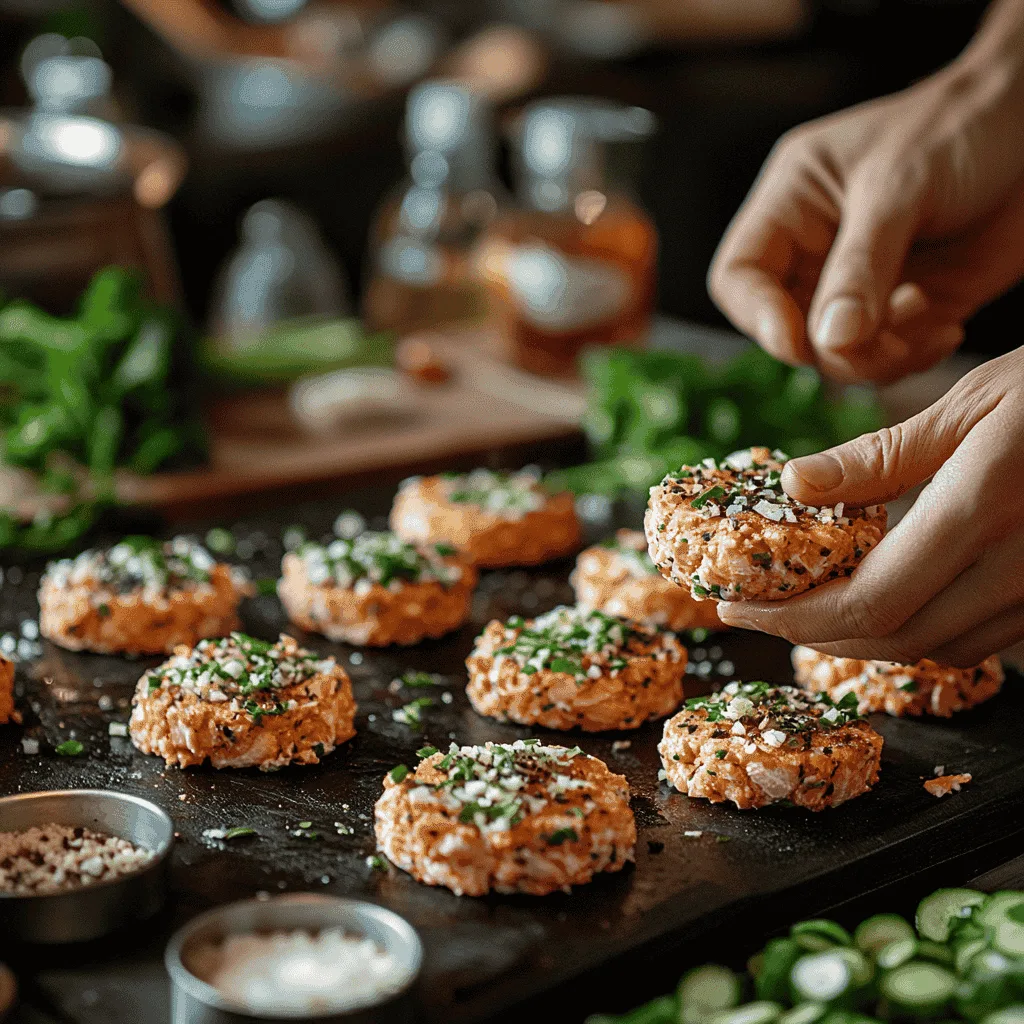
Image source: Bing (Web (fair-use with source credit))
Step 4: Form the patties.
Wet your hands with cold water to prevent sticking. Scoop about ⅓ cup of the salmon mixture and shape it into a patty roughly 2.5 inches in diameter and ½ inch thick. Place each patty on a plate or parchment-lined tray.
From one standard can, expect 4 to 6 patties depending on how large you form them.
Step 5: Preheat the air fryer.
Set the temperature to 375°F and let the empty air fryer run for 3 to 5 minutes. Preheating creates an immediate sear on the patty surface when it contacts the hot basket, reducing sticking and jump-starting Maillard browning on the exterior. If your model lacks a dedicated preheat button, simply running it at the target temperature for a few minutes produces the same effect.
Step 6: Arrange patties in the basket with spacing.
Place each patty in a single layer with at least 1 inch of clearance on all sides. Overlapping or touching patties trap steam between them instead of crisping the surface. A standard 5-to-6-quart basket comfortably holds 4 patties.
If you're using a larger 9-quart air fryer for large batches, you can fit 6 to 8, but work in batches if needed rather than crowding.
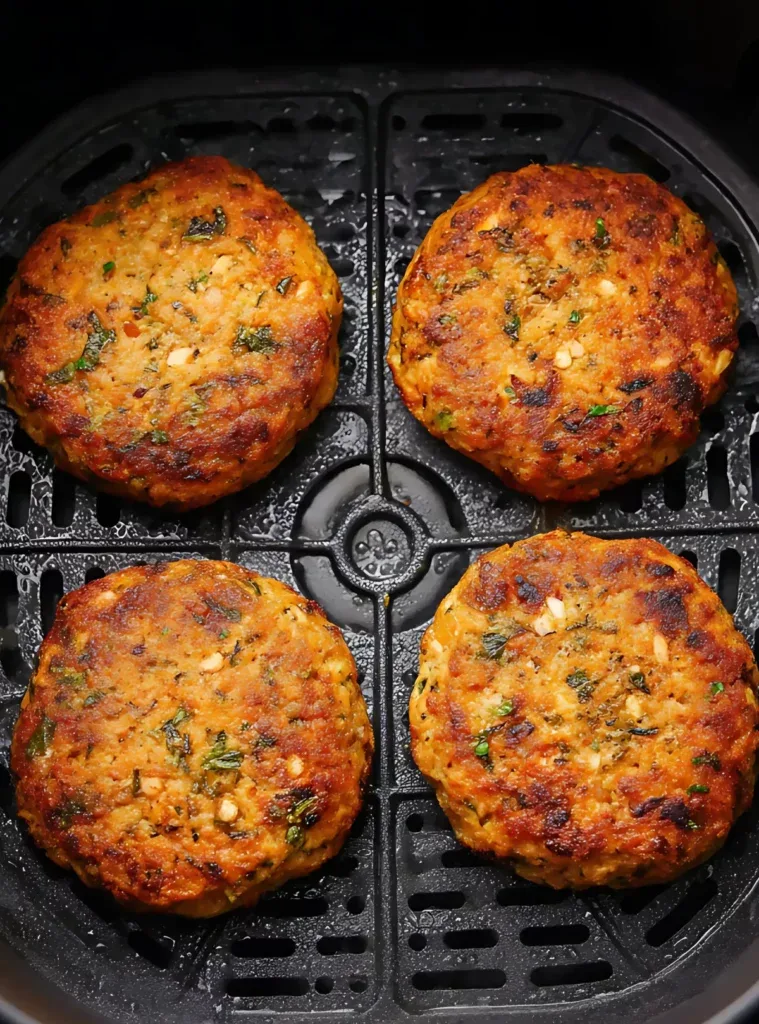
Image source: Bing (Web (fair-use with source credit))
Step 7: Apply oil and cook.
Mist the tops of the patties lightly with avocado oil or olive oil from a refillable mister. Cook at 375°F for 5 minutes, then gently flip each patty using a thin fish spatula. Mist the second side with oil and cook for another 4 to 6 minutes until the exterior is deep golden brown and an instant-read thermometer inserted into the center reads 145°F.
Step 8: Rest briefly and serve.
Transfer the patties to a plate and let them sit for 1 to 2 minutes before serving. This short rest lets residual heat finish setting the interior structure and makes the patties easier to handle without cracking. Serve over a simple green salad, on a toasted brioche bun with tartar sauce, or alongside roasted vegetables.
If you're making salmon patties as part of a weekly meal prep routine, they pair well with other air fryer staples. Air fryer bratwurst cooks in the same appliance in about 12 minutes, and a batch of air fryer banana chips handles dessert with zero extra cleanup.
Air Fryer Model Differences: Why Your Results Vary
Not all air fryers cook salmon patties the same way, and understanding why your neighbor's perfect result doesn't match yours usually comes down to three technical factors: wattage, basket shape, and heating element placement.
Wattage determines heat intensity and recovery speed. Most consumer air fryers range from 800 watts on compact models to 1,800 watts on premium units. A 1,400-watt model like the Instant Vortex recovers temperature faster after you open the basket to flip patties, while an 800-watt unit drops more degrees during the same pause and needs extra cook time to compensate. Manufacturer guides for the Philips Airfryer line acknowledge that wattage variance can shift cook times by 1 to 3 minutes for the same recipe.
Basket type affects airflow contact around each patty. Drawer-style baskets (found in models like the Cosori and Instant Vortex) pull out horizontally and tend to expose all sides of the patty relatively evenly. Oven-style air fryers with front-opening doors and tray racks (like the Ninja Foodi Dual Zone) place patties on a flat tray, meaning the bottom receives less direct airflow. If your patties have pale but well-browned tops, your model likely uses a top-mounted heating element, and you may need to extend cook time by 1 to 2 minutes or flip more than once.
Image source: Bing (Web (fair-use with source credit))
The Instant Vortex Air Fryer is one of the most commonly cited models in user recipe tests for salmon patties. Its 1,700-watt element and perforated basket design produce consistent results at the 375°F to 400°F range with a cook time of 9 to 11 minutes for ½-inch-thick patties. If you're using a different model, treat published cook times as starting points: check 1 to 2 minutes before the low end of any recommended range.
Quick model guide for salmon patties:
| Factor | Drawer/Basket Style | Oven/Tray Style | Multi-Function (e.g., Instant Pot lid) |
|---|---|---|---|
| Airflow contact | All sides relatively even | Bottom may undercook | Moderate, depends on lid seal |
| Flip needed | Once at midpoint | Once, consider rotating tray | Once at midpoint |
| Typical cook time (½-inch patty at 375°F) | 9–11 minutes | 10–13 minutes | 10–12 minutes |
| Temperature recovery after flip | Fast (1,400W+) | Slower (800–1,200W) | Moderate |
If you own a multi-function appliance like the Instant Pot with an air fryer lid, the cooking dome geometry concentrates heat differently from a standalone air fryer. Cook times may run longer by 1 to 2 minutes and the browning pattern can be slightly less even. Not sure whether your air fryer qualifies as a true convection device?
The difference between an Instant Pot and an air fryer matters for getting this recipe right. Before you invest in any new appliance, it's worth confirming that a dual-basket 8-quart model or a high-wattage combo unit actually fits your cooking style, since size and power both affect patty results. If you're unsure about your specific model's dishwasher-safe status before loading it up, check the cleaning guide for the Instant Vortex first.
Temperature and Timing: The Sweet Spot for Crispy, Cooked-Through Patties
Getting the temperature and timing dialed in makes the difference between dry, overcooked patties and ones that are golden on the outside and moist within. Across manufacturers' recipe databases and cooking community feedback, a narrow window consistently produces the best results.
For standard ½-inch-thick patties, 375°F hits the ideal balance between browning speed and interior heating. At this temperature, the Maillard reaction produces visible golden-brown color in 8 to 10 minutes while the interior climbs steadily toward the FDA's 145°F safety threshold. If you prefer a darker crust, 400°F gets you there in 7 to 9 minutes, but the narrower window between golden and burnt demands closer monitoring, especially above 1,500 watts.
Temperatures below 350°F risk drying out the patty before any meaningful browning occurs because the exterior loses moisture faster than the surface temperature can rise.
The flip is non-negotiable for even cooking. Cooks who skip the flip consistently report one side that is properly browned and another that looks steamed and pale. Flipping at the halfway mark (so around the 4-to-5-minute point at 375°F) lets both sides hit direct circulating air.
Use a thin fish spatula, slide it fully under the patty, and turn it in one confident motion. Hesitation or partial lifting cracks the crust that just formed.
For frozen patties, adding 3 to 4 minutes to the total cook time and starting at 360°F (rather than 375°F) gives the frozen center time to thaw before the exterior over-browns. Once the patty softens slightly at the 6-minute mark, you can bump the temperature to 375°F for the remaining cook time to finish crisping. Directly from the freezer to 400°F almost always produces a burnt exterior and an ice-cold center.
Temperature and timing quick reference:
| Patty Thickness | Starting Temp | Total Cook Time (fresh) | Total Cook Time (from frozen) | Flip At |
|---|---|---|---|---|
| ½ inch | 375°F | 9–11 minutes | 12–14 minutes | 5 minutes |
| ¾ inch | 375°F | 11–13 minutes | 14–16 minutes | 6 minutes |
| 1 inch | 360°F | 13–15 minutes | 16–18 minutes | 7 minutes |
Always verify doneness with an instant-read thermometer rather than relying solely on external color. Dark browning at 400°F can look done while the center sits at only 130°F. Insert the probe into the thickest part of the patty from the side for the most accurate reading.
The target is 145°F, and residual heat will carry it a degree or two higher during the 1-to-2-minute rest.
How to Tell When They're Done Without Cutting Them Open
Cutting into a salmon pattery to check doneness releases juices that should stay inside. Experienced cooks rely on a combination of visual and tactile cues instead.
The exterior should be a uniform golden-brown on both sides with slightly darker edges where the crumb coating thins out. The surface should appear dry to the touch, not shiny or wet. When you press the center gently with a fingertip through a thin spatula or a clean finger (carefully, as the patty is hot), a finished patty should feel firm at the edges and slightly springy in the center.
A raw or undercooked patty feels soft and mushy throughout, with no resistance.
An instant-read thermometer remains the most reliable method. Insert the probe horizontally into the side of the patty until the tip reaches the center without pushing through the other side. Readings of 140°F to 142°F at the thickest point mean the patty will coast up to the 145°F FDA target during the rest period.
If you read 135°F or below after the full recommended cook time, return the patty to the air fryer for another minute and recheck.
The flake test offers a second quick confirmation. Press the edge of the patty gently with a fork. Cooked salmon flesh separates into clean, defined flakes.
If it resists and looks translucent or uniform without flaking, it needs another minute. This test requires touching the patty and slightly disrupts the exterior, so many home cooks save it for the final patty to confirm the batch is complete before pulling anything from the air fryer basket.
Air Fryer vs. Pan-Fried vs. Oven-Baked Salmon Patties
Each method produces a meaningfully different result, and choosing the right cooking technique for your situation matters more than most recipe posts suggest. Here's how the three most common approaches stack up for salmon patties specifically.
The air fryer circulates air at high speed around each patty using a top-mounted heating element and a small fan, producing a crisp crust with roughly one-third of the oil required for pan-frying. A 2021 study published in the Journal of Food Science showed that air-fried patties absorbed 33% less oil during cooking compared to pan-fried equivalents. Pan-frying in a skillet on the stovetop uses a thin layer of oil in direct contact with the patty bottom, creating the most intense browning on one surface.
Oven-baking in a full-size conventional oven surrounds patties with static hot air and produces a more uniform but less crispy exterior across all sides.
Side-by-side comparison for salmon patties:
| Method | Total Oil (per batch of 4) | Cook Time | Crust Quality | Hands-On Time | Cleanup Effort |
|---|---|---|---|---|---|
| Air fryer (375°F) | ~2 tsp (misted) | 9–11 min | Crispy, even all around | Low (set and flip) | Minimal (basket only) |
| Pan-fried (medium heat, skillet) | ~2 tbsp (in pan) | 10–12 min min total | Crispy bottom, softer top (flip needed) | Moderate (standing at stove) | Moderate (skillet + spatula + stovetop) |
| Oven-baked (400°F, sheet pan) | ~1 tbsp (on sheet) | 15–18 min | Lightly crisp, uniform | Minimal (set timer) | Minimal (parchment or foil on sheet) |
The air fryer wins on oil efficiency and consistent all-around crispiness, but pan-frying still delivers the most dramatic single-side crunch when that's the texture you want. Oven-baking is the best choice when you're making a large batch (8 or more patties), since a sheet pan handles more volume comfortably than any standard air fryer basket. If you're weighing the overall value of adding an air fryer to your kitchen, comparing the Instant Pot vs. air fryer head-to-head shows the air fryer's advantage for crispy proteins like salmon patties, while the Instant Pot tends to steam ingredients more than crisp them.
Common Seasoning Blends That Actually Work
Salmon has enough natural flavor that you don't need much, but the right seasoning blend elevates a basic patty into something you'd pay for at a restaurant. The key is matching the seasoning intensity to the salmon type.
Old Bay Seasoning is the classic pairing for sockeye or Atlantic salmon. Its celery seed, paprika, and mustard profile has complemented fish for decades and needs no additional salt. Sprinkle about 1 teaspoon into the patty mixture before forming.
For a lighter, herbaceous profile on pink salmon, combine the zest of one whole lemon, 1 tablespoon of chopped fresh dill or 1 teaspoon dried dill, ½ teaspoon of garlic powder, and a pinch of black pepper. Cajun seasoning blends work best with sockeye or skin-on Atlantic fillets, applying about 1.5 teaspoons to the mix and the optional addition of a dash of hot sauce into the wet ingredients for depth.
Smoked paprika and a small amount of cumin create a Southwest-inspired patty that pairs well with avocado or chipotle mayo on a bun. Allow approximately 1 teaspoon of smoked paprika and ½ teaspoon of ground cumin per batch. If you prefer Asian-inspired flavors, using 1 teaspoon of soy sauce (replacing some of the lemon juice), a dash of sesame oil, and a sprinkle of furikake over the formed patties just before cooking delivers a surprisingly different result that works especially well with unbreaded patties or those using panko for an extra Asian-style crunch.
For kid-friendly seasonings, a simple mix of onion powder, garlic powder, and a tiny pinch of sugar (which promotes browning) appeals broadly. Avoid heavy spice for young palates, as even mild black pepper can dominate a mild pink salmon patty.
Quick seasoning cheat sheet:
| Blend | Key Ingredients | Best With | Amount per Batch |
|---|---|---|---|
| Classic seafood | Old Bay, lemon wedge for serving | Sockeye, Atlantic | 1 tsp Old Bay |
| Lemon-dill | Lemon zest, fresh dill, garlic powder, black pepper | Pink salmon, mild fish | Zest of 1 lemon, 1 Tbsp dill |
| Cajun | Cajun seasoning blend, optional hot sauce | Sockeye, any bold fish | 1.5 tsp Cajun blend |
| Southwest | Smoked paprika, cumin, garlic | Any, especially avocado pairings | 1 tsp smoked paprika, ½ tsp cumin |
| Asian-inspired | Soy sauce, sesame oil, furikake | Any, especially panko or unbreaded | 1 tsp soy sauce + dash sesame oil |
| Kid-friendly | Onion powder, garlic powder, pinch of sugar | Pink salmon, mild fish | ½ tsp each powder |
Meal Prep and Make-Ahead: Batch Cooking Salmon Patties
Salmon patties are one of the best protein options for batch cooking because they hold up well in the fridge and reheat cleanly in the air fryer. A single batch takes about 25 minutes start to finish, so doubling or tripling the recipe is efficient without feeling like an all-day project.
Prepare the salmon mixture as described above, form all patties, and cook them in batches depending on your air fryer basket size. Once cooked, cool the patties completely on a plate at room temperature for about 15 minutes before storing. Place them in a single layer in an airtight container with parchment paper between each patty to prevent sticking.
Properly stored at or below 40°F in a refrigerator, cooked salmon patties stay safe and maintain quality for 3 to 4 days according to USDA FSIS leftover guidelines.
Uncooked patties freeze even better than cooked ones. Form patties, place them on a parchment-lined baking sheet, and freeze solid for about 1 hour before transferring to a zip-top freezer bag with parchment between each layer. This flash-freeze step prevents patties from clumping into one frozen mass.
Frozen uncooked patties keep for up to 3 months at 0°F in a standard home freezer. Label the bag with the date and seasoning blend, since different batches taste noticeably different.
When batch-cooking, consider varying the seasoning by splitting the base mixture into two bowls and seasoning each differently. One batch gets Old Bay for classic fans, while the other gets a Cajun blend or kid-friendly version. This variety prevents meal-prep fatigue across a week of daily salmon patties.
Storage overview:
| State | Container | Fridge Life (≤40°F) | Freezer Life (0°F) | Reheat Method |
|---|---|---|---|---|
| Uncooked, fresh | Airtight container, parchment between | 1–2 days | Up to 3 months | Air fry from frozen: 360°F→375°F, 12–14 min |
| Cooked | Airtight container, parchment between | 3–4 days | Up to 2 months | Air fry at 350°F for 3–4 min |
| Flash-frozen uncooked | Zip-top freezer bag, parchment between | N/A | Up to 3 months | Air fry from frozen: 360°F→375°F, 12–14 min |
Reheating Leftover Salmon Patties So They Stay Crispy
Microwaving reheated salmon patties turns the coating soggy and the fish rubbery. An air fryer restores the crisp exterior in just a few minutes. This is the one appliance where leftovers genuinely taste close to freshly cooked.
Preheat the air fryer to 350°F for 2 to 3 minutes. Place cold patties from the refrigerator in a single layer with spacing between them. Do not stack or overlap.
Cook for 3 to 4 minutes until the exterior feels dry and crisp when tapped lightly, and the interior is warmed through. No oil misting is necessary for refrigerated leftovers, since enough oil remains in the coating from the original cook to re-crisp.
For reheating from frozen, spread frozen patties in the basket and cook at 350°F for 2 minutes to thaw the surface, then increase to 375°F and cook for another 4 to 5 minutes until hot throughout. Skipping the initial low-temperature stage on frozen patties leads to a cold center with an over-browned exterior. Let the patties rest for 1 minute after reheating before eating, since the interior holds intense heat.
If your air fryer is a larger 8-quart model, use the same method regardless of capacity, since patties only need a single layer.
The patties will never be quite as crisp on the second cook. Panko crust absorbs moisture from the refrigerator, and oil redistributes within the coating over time. A squeeze of fresh lemon over reheated patties refreshes the flavor and adds brightness that compensates for the slightly softer texture.
Keto, Gluten-Free, and Other Dietary Swaps
Salmon patties adapt easily to most dietary restrictions because the base formula (salmon, binder, seasoning) is already naturally gluten-free and low in carbohydrates. Modifying the coating and binders covers the vast majority of dietary needs with minimal texture compromise.
Keto and low-carb diets benefit from replacing breadcrumbs with almond flour (about 3g net carbs per 2 tablespoons) or crushed pork rinds (0g net carbs). Reduce the air fryer temperature by 15°F to 25°F since nut flours and protein-based coatings brown faster than wheat flour. Some keto cooks thicken the patty mixture with a small amount of cream cheese (1 to 2 tablespoons), which adds richness and acts as a binder without introducing carbs.
Gluten-free adaptations simply swap standard breadcrumbs and panko for certified gluten-free versions, which are widely available from brands likeIan's and 45080 Breadcrumbs. Gluten-free breadcrumb texture can be slightly more crumbly than wheat-based versions, so increasing the egg by one extra yolk (or half an egg white) provides more structural support and prevents cracking during the flip.
For egg-free or vegan-adjacent diets where eggs are excluded, one "flax egg" (1 tablespoon of ground flaxseed mixed with 3 tablespoons of water, set aside for 5 minutes to gel) successfully replaces each egg in this recipe. Expect slightly less binder power, so chilling the formed patties for a full 15 minutes before cooking becomes essential.
Dairy-free versions need no modifications since the base recipe contains no dairy unless you choose to add it. Simply avoid tartar sauce or creamy dips on the finished patties. Paleo-friendly patties use almond flour or cassava flour as the coating, skip any pre-made seasoning blends that contain anti-caking agents or sugar, and rely on single-ingredient spices mixed at home.
Dietary swap quick reference:
| Dietary Need | Coating Swap | Binder Swap | Temp Adjustment |
|---|---|---|---|
| Keto | Almond flour or crushed pork rinds | Standard egg (already low carb) | –15°F to –25°F |
| Gluten-free | GF breadcrumbs or GF panko | Standard egg | No change |
| Egg-free | Standard breadcrumbs or panko | Flax egg (1 Tbsp flax + 3 Tbsp water) | No change |
| Paleo | Almond flour or cassava flour | Standard egg | –15°F to –25°F |
| Low-sodium | Unseasoned breadcrumbs | Standard egg; use herb-heavy blends, skip salt | No change |
Frozen Salmon Patties in the Air Fryer: From Freezer to Plate
Cooking salmon patties straight from frozen saves time on busy nights and avoids the texture loss that comes from thawing in a microwave. The key is starting at a low temperature, then finishing at a higher one.
Use the flash-freeze method described in the meal prep section: freeze formed patties on a parchment-lined tray until solid, then transfer to a freezer bag. Preheat the air fryer to 360°F. Place frozen patties in a single layer in the basket with spacing between each one.
Do not thaw before cooking, since thawing releases liquid from the fish and makes the surface mushy and difficult to brown.
Cook at 360°F for 6 minutes. The low starting temperature thaws the interior gradually without scorching the coating open. After 6 minutes, increase the temperature to 375°F and cook for another 5 to 7 minutes until the exterior reaches golden-brown and the center reads 145°F.
For thick frozen patties (¾ inch or more), extending the initial low-temp phase to 8 minutes produces better results throughout.
The total cook time for frozen patties runs 11 to 13 minutes at the thickness ranges described above. Skipping directly to 375°F or 400°F from frozen produces a dark, crunchy exterior and a cold center that no amount of additional cooking fully corrects without drying out the patty edges. If using a preprinteded air fryer basket, parchment liners or perforated air fryer parchment prevent any frozen-sticking issues.
Those using a dual-basket model can cook one basket of frozen patties while preparing a fresh side in the other, making the most of the appliance's capacity.
Frequently Asked Questions
Can I use canned salmon bones in the patties?
Yes. The small soft pin bones in canned salmon are edible and provide calcium. They soften completely during mixing and cooking.
If the texture bothers you, remove them by running your fingers along the flaked salmon and pulling each bone out with tweezers before mixing.
Why do my salmon patties keep falling apart?
Excess moisture in the mixture is the most common cause. Drain canned salmon thoroughly, and if the mixture feels wet after mixing, add breadcrumbs one tablespoon at a time until it holds together when squeezed. Chilling the mixture for 10 to 15 minutes before forming also helps enormously.
Do I need to preheat the air fryer for salmon patties?
Yes. Preheating to 375°F for 3 to 5 minutes before loading the patties creates an immediate sear on contact, which reduces sticking and jumpstarts browning. Skipping preheat leads to pale, unevenly cooked patties that may stick to the basket.
How many salmon patties can I cook at once in a standard air fryer?
A 5-to-6-quart basket holds 4 patties comfortably with 1 inch of spacing on all sides. A 9-quart model handles 6 to 8. Overcrowding blocks airflow and causes steaming instead of crisping, so work in batches if needed.
Are air fryer salmon patties healthy?
Salmon is a nutrient-dense protein rich in omega-3 fatty acids, vitamin D, and B12. Air frying uses significantly less oil than deep-frying or pan-frying, making the patties lower in added fat while still delivering a crispy coating. The FDA lists salmon as a "Best Choice" fish for its low mercury content.
Can I make salmon patties without breadcrumbs?
Yes. Almond flour, crushed pork rinds, or no coating at all all work. Unbreaded patties develop a thin, delicate crust from the oil mist alone.
For keto or low-carb versions, almond flour is the most popular substitute, though it browns faster and benefits from a 15°F to 25°F lower cooking temperature.