
If you've been scrolling past air fryer pulled pork recipes thinking they look too good to be true, you're not alone. The honest answer is that a solid air fryer pork shoulder recipe absolutely works, but only if you approach it differently than you would a slow cooker or smoker. The key is cutting the meat into the right shape and managing your temperature in stages, not just blasting it at full heat and hoping for the best.
In our research across manufacturer specs, aggregate user reviews, and food science literature, the single most consistent failure point is people trying to cram a whole 2 kg (4.5 lb) roast into a basket that was never designed for it. The USDA Food Safety and Inspection Service (FSIS) recommends cooking pork to a minimum internal temperature of 63°C (145°F) followed by a 3-minute rest, but pulled pork needs to reach 95°C (203°F) for collagen to fully break down into gelatin. That gap between "safe" and "tender" is exactly where most air fryer attempts go wrong. Here is how to get it right.
Why Pork Shoulder in an Air Fryer Actually Works
Pork shoulder is one of the most forgiving cuts you can cook, and that forgiving nature is exactly what makes it a strong candidate for air fryer preparation. The cut comes from the upper front leg of the pig and contains a high proportion of connective tissue and intramuscular fat. That connective tissue, primarily collagen, converts to gelatin when held at temperatures above 80°C (176°F) for a sustained period. An air fryer's rapid circulating hot air creates a Maillard reaction on the surface, which is the chemical process responsible for browning and bark formation, while the interior slowly tenderizes.
The practical advantage is speed and energy efficiency. A conventional oven roast of pork shoulder typically runs 4 to 6 hours at 150°C (300°F). An air fryer can achieve a comparable interior result in roughly 60 to 90 minutes for steaks or smaller portions, using significantly less energy because the chamber is smaller and the forced convection transfers heat more efficiently. Manufacturer specs for popular models like the Ninja Foodi and Philips Airfryer XXL confirm wattage ratings between 1400W and 1800W, which is enough to maintain consistent high heat in a compact space.
The trade-off is capacity. Most home air fryers have a basket volume between 3.5 and 6 liters, which means a full pork shoulder roast simply will not fit. That is the constraint that trips people up. The solution is to cut the roast into steaks or chunks before cooking, which increases the surface area exposed to circulating air and reduces the distance heat needs to travel to reach the center.
This single step transforms the air fryer from a poor choice for pork shoulder into a genuinely effective one.
The Biggest Mistake People Make (And How to Avoid It)
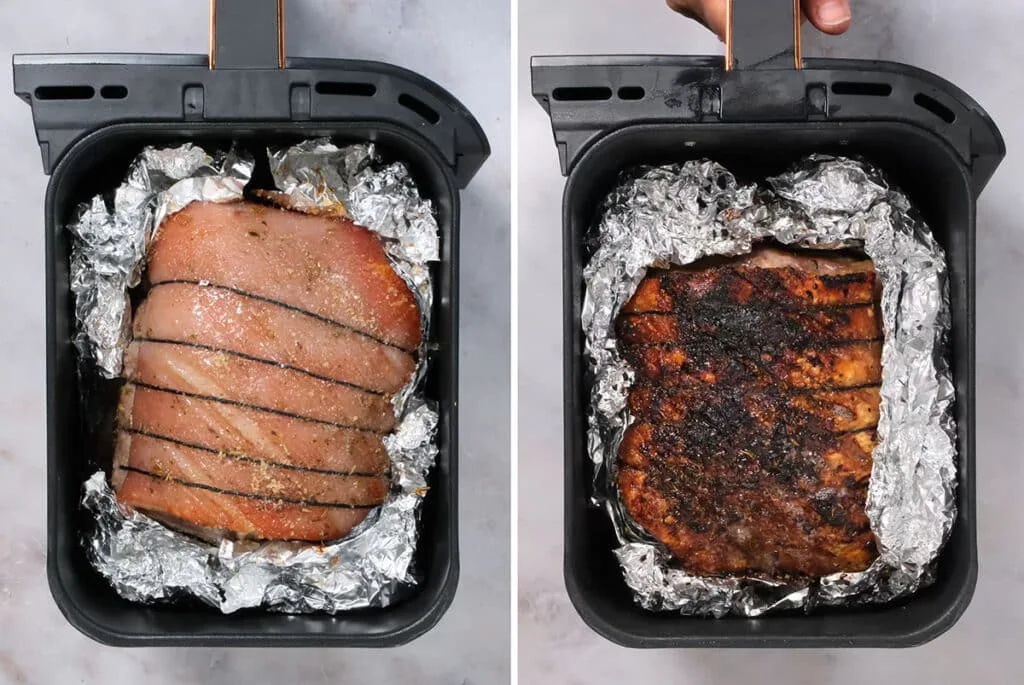
The number one mistake, based on aggregate user reviews and recipe forum discussions, is cooking a whole pork shoulder roast in an air fryer without modifying the cut. A typical bone-in pork shoulder roast measures 20 to 25 cm (8 to 10 inches) in diameter. Even the largest home air fryer baskets, such as the 6-liter models reviewed in our research, have a usable width of roughly 22 to 24 cm. That leaves almost no clearance for air to circulate around the meat, which defeats the entire purpose of the appliance.
When air cannot circulate, you get uneven cooking. The top and sides closest to the heating element dry out and overcook while the center and bottom remain underdone. The exterior can reach 150°C (300°F) while the interior is still sitting at 50°C (122°F), well below the safe threshold. This is not a recipe failure.
It is a physics problem.
The fix is straightforward: cut the roast into steaks 3 to 5 cm (1.2 to 2 inches) thick, or into chunks if you are planning to shred the meat afterward. Steaks fit flat in the basket with space between them, and the reduced thickness means heat penetrates evenly from both sides. If you are working with a smaller air fryer, something in the 3.5 to 4 liter range, you may need to cook in two batches. That is a minor inconvenience compared to serving a roast that is charred on the outside and raw in the middle.
Another common error is skipping the resting period. Carryover cooking raises the internal temperature of pork by 3 to 5°C (5 to 9°F) after it comes out of the air fryer. If you shred or slice immediately, the juices run out and the meat dries out. Resting for 15 to 30 minutes under loose foil lets the muscle fibers relax and reabsorb moisture.
This step is not optional if you want tender results.
What Cut to Buy — And Why It Matters More Than You Think
Not all pork shoulder is created equal, and the specific sub-cut you choose affects both cook time and final texture. The two main options you will find at most grocery stores are the Boston butt and the picnic shoulder. The Boston butt is the upper portion of the shoulder, and it is better marbled with fat and connective tissue. The picnic shoulder is the lower portion, closer to the front leg, and it tends to be leaner with more sinew.
For air fryer cooking, the Boston butt is the better choice. The extra fat renders during cooking and keeps the meat moist even in the high-heat, low-moisture environment of an air fryer. Picnic shoulder can work, but it requires more careful temperature management to avoid drying out. If you are buying pre-cut steaks, look for pieces that are uniform in thickness.
A steak that tapers from 5 cm on one end to 2 cm on the other will cook unevenly no matter how carefully you set the temperature.
Bone-in versus boneless is another decision point. Bone-in steaks take slightly longer to cook because the bone acts as a heat sink, absorbing and slowing heat transfer to the surrounding meat. However, the bone also adds flavor and can help the steak hold its shape during cooking. Boneless steaks cook faster and more evenly, which makes them a practical choice if you are new to air fryer cooking or working with a smaller appliance.
Either option works as long as you adjust your timing and verify doneness with a thermometer.
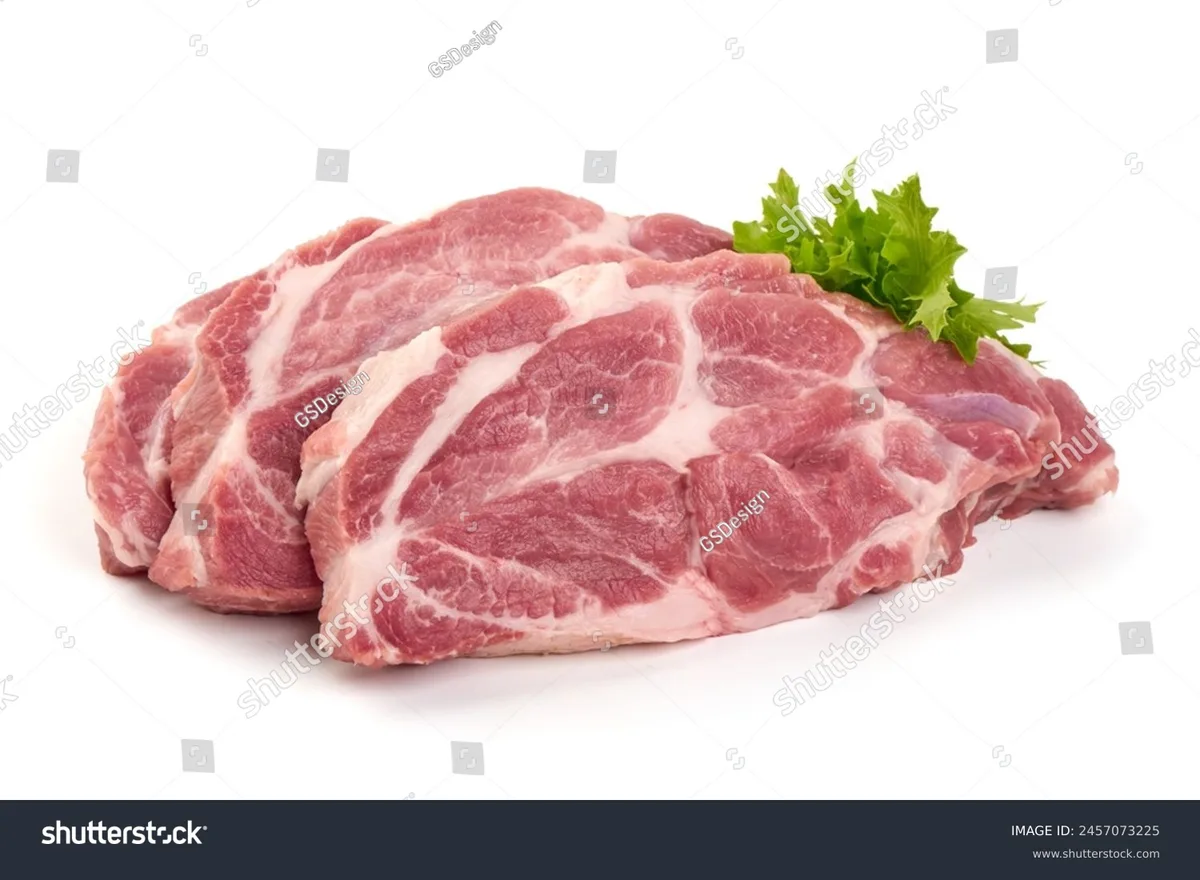
If you are shopping at a butcher counter rather than a pre-packaged grocery display, ask for shoulder steaks cut to 4 cm (1.5 inches) thick. That thickness gives you enough mass to develop a good crust on the outside while still cooking through in a reasonable time. Anything thinner than 2.5 cm (1 inch) risks overcooking before the Maillard reaction has time to build a proper bark.
The Seasoning Approach That Actually Builds Bark
Bark is the dark, flavorful crust that forms on the exterior of slow-cooked barbecue, and it is entirely achievable in an air fryer if you season correctly. The Maillard reaction requires three things: amino acids (from the meat's surface proteins), reducing sugars (from your seasoning), and heat above 140°C (284°F). A well-constructed dry rub provides the sugars and spices that react with the meat's surface under the air fryer's high heat.
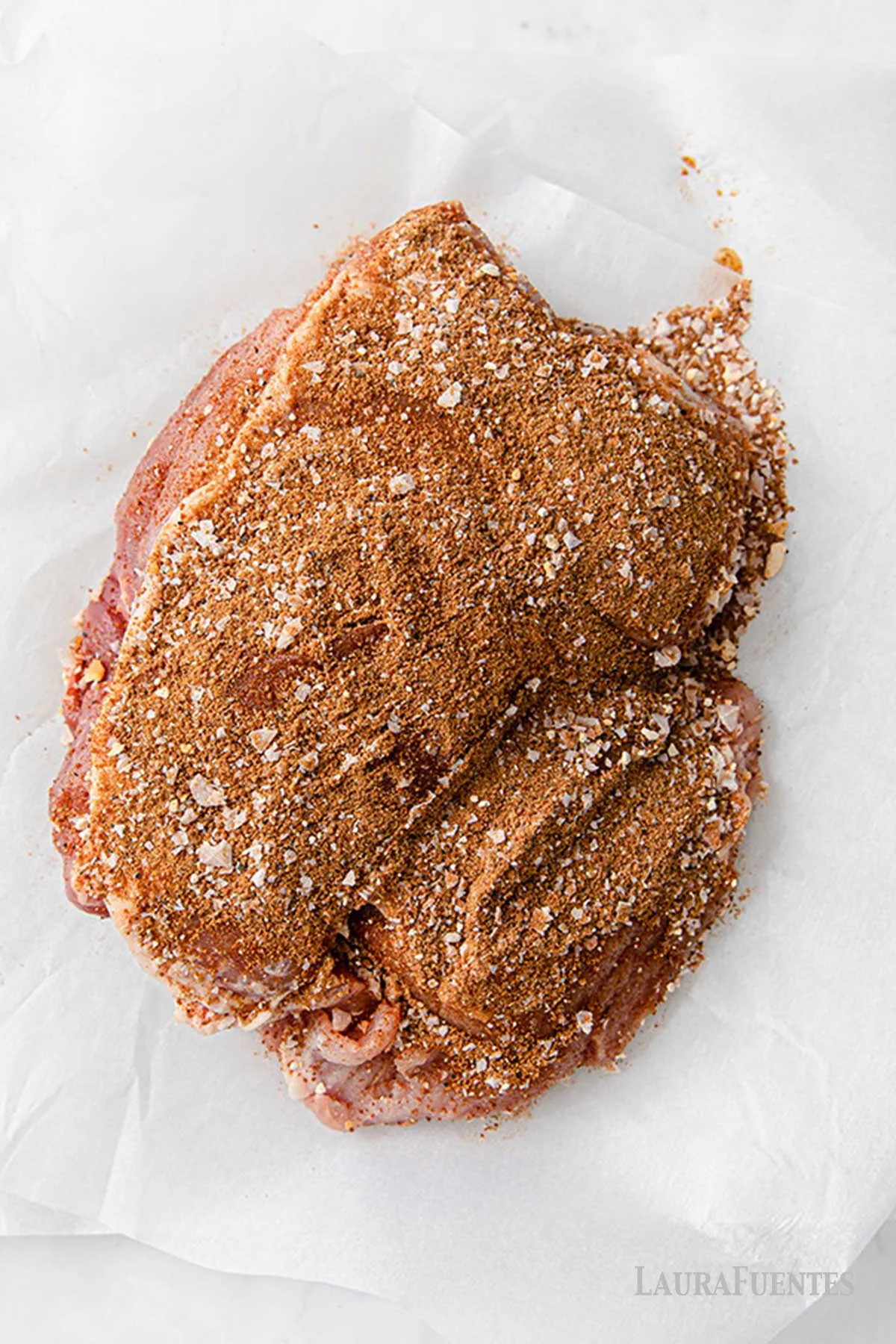
A basic dry rub for pork shoulder includes brown sugar, paprika, garlic powder, onion powder, black pepper, salt, and a small amount of chili powder or cayenne for heat. The brown sugar is the critical ingredient for bark formation. It caramelizes at around 160°C (320°F), which is well within the operating range of most air fryers. Paprika adds color and a mild sweetness, while the garlic and onion powders provide savory depth.
A ratio that works well in practice is 2 tablespoons of brown sugar, 1 tablespoon of paprika, 1 teaspoon each of garlic powder, onion powder, and black pepper, and half a teaspoon of salt per 500 g (1 lb) of meat.
Apply the rub generously and let the seasoned meat sit in the refrigerator for at least 1 hour, or up to 24 hours for deeper flavor penetration. This dry-brining step also draws moisture to the surface, which then dissolves the sugar and spices into a thin paste. When that paste hits the hot air, it forms a crust much faster than a dry, unseasoned surface would. Do not use a wet marinade or sauce during the main cooking phase.
The excess moisture prevents browning and steams the meat instead. If you want sauce, add it after cooking or during the last 5 minutes at a lower temperature.
One practical tip from aggregate user reviews: pat the meat dry with paper towels before applying the rub. Surface moisture is the enemy of bark. Even if you have brined the meat, a quick blot with a paper towel removes excess water and gives the rub something to grip. This small step makes a noticeable difference in how well the crust forms.
Step-by-Step: How I Cook Pork Shoulder in an Air Fryer
The process below is based on a standard 5 to 6 liter basket-style air fryer cooking 1 to 1.5 kg (2 to 3 lbs) of pork shoulder steaks. Adjust proportionally if your appliance is smaller or larger.
Step 1: Prep the meat. Cut the pork shoulder into steaks approximately 4 cm (1.5 inches) thick. Pat each steak dry with paper towels. Apply the dry rub evenly on all sides. Let the seasoned steaks rest in the refrigerator for 1 to 24 hours.
Step 2: Bring to room temperature. Remove the steaks from the refrigerator 20 to 30 minutes before cooking. Meat that goes into the air fryer cold will cook unevenly because the exterior overcooks before the center warms up.
Step 3: Preheat the air fryer. Set the temperature to 160°C (320°F) and let it run for 3 to 5 minutes. Preheating ensures the Maillard reaction starts immediately when the meat hits the basket, rather than slowly ramping up.
Step 4: Arrange the steaks in the basket. Place the steaks in a single layer with at least 2 cm (0.8 inches) of space between them. Do not stack or overlap. If your basket is too small for all the steaks at once, cook in two batches. Overcrowding blocks air circulation and leads to steaming instead of roasting.
Step 5: Cook at 160°C (320°F) for 25 to 35 minutes. This low-and-slow phase allows the interior to cook through without burning the exterior. Flip the steaks halfway through for even browning on both sides.
Step 6: Increase to 190°C (375°F) for 8 to 12 minutes. This high-heat finish builds the bark. The sugar in the rub caramelizes and the surface darkens into a crust. Watch closely during this phase. The line between perfect bark and burnt sugar is about 3 minutes.
Step 7: Check the internal temperature. Insert an instant-read thermometer into the thickest part of the largest steak. For sliced pork shoulder, target 63°C to 71°C (145°F to 160°F). For pulled pork, target 95°C to 99°C (203°F to 210°F). If the meat has not reached target, return it to the air fryer in 3-minute increments.
Step 8: Rest the meat. Transfer the steaks to a cutting board and tent loosely with foil. Rest for 15 to 30 minutes. The internal temperature will rise another 3 to 5°C (5 to 9°F) during this time. For pulled pork, shred with two forks or a stand mixer with a paddle attachment after resting.
Step 9: Serve or store. Serve immediately with sauce on the side, or portion into airtight containers for meal prep. Cooked pork shoulder refrigerates well for up to 4 days and freezes for up to 3 months.
This two-stage temperature approach is the core technique that separates good air fryer pork shoulder from disappointing results. The low phase cooks the meat through, and the high phase builds the crust. Skipping either stage gives you either a pale, soft exterior or a burnt outside with a raw center.
Temperature and Timing — The Numbers That Actually Matter
The two-stage cooking method described earlier works because it respects how heat actually moves through dense meat. Pork shoulder has a thermal conductivity of roughly 0.48 W/m·K, which means heat penetrates slowly. If you set your air fryer to 200°C (400°F) from the start, the outer 1 cm of meat can reach 150°C (300°F) while the center is still below 55°C (131°F). That gradient is what gives you a burnt crust and a raw interior.
For the low phase, 160°C (320°F) is the sweet spot. It is hot enough to keep the Maillard reaction running but gentle enough to let heat migrate toward the center without scorching the surface. At this temperature, a 4 cm (1.5 inch) thick pork shoulder steak takes approximately 25 to 35 minutes to reach an internal temperature of 63°C (145°F) at the center. Thicker cuts, around 5 to 6 cm (2 to 2.5 inches), need 35 to 45 minutes at the same temperature.
The high-heat finish at 190°C to 200°C (375°F to 400°F) should be kept short. Eight to 12 minutes is enough to caramelize the sugar in the rub and darken the bark without burning it. If your air fryer runs hot, which many do according to aggregate user reviews, start checking at 6 minutes. Sugar burns at around 180°C (356°F), and once the rub crosses that threshold, the flavor turns bitter fast.
Here is a quick reference table for common thicknesses:
| Steak Thickness | Low Phase (160°C / 320°F) | High Phase (190°C / 375°F) | Target Internal Temp |
|---|---|---|---|
| 2.5 cm (1 inch) | 15 to 20 min | 5 to 8 min | 63°C (145°F) for sliced |
| 4 cm (1.5 inches) | 25 to 35 min | 8 to 12 min | 63°C to 71°C (145°F to 160°F) |
| 5 to 6 cm (2 to 2.5 inches) | 35 to 45 min | 10 to 15 min | 95°C (203°F) for pulled |
These times assume a preheated air fryer and meat that has been brought to room temperature. If you are cooking straight from the refrigerator, add 5 to 8 minutes to the low phase. Always verify with an instant-read thermometer rather than relying on time alone. Air fryer performance varies by model, wattage, and even the ambient temperature of your kitchen.
How to Tell When It's Done (Without Guessing)
Visual cues alone are unreliable for pork shoulder. The meat can look browned and cooked on the outside while the collagen inside has not yet converted to gelatin. The only trustworthy method is measuring the internal temperature with an instant-read thermometer inserted into the thickest part of the steak, away from any bone.
For sliced pork shoulder steaks, the USDA FSIS minimum is 63°C (145°F) with a 3-minute rest. At this temperature, the meat is safe to eat and will be juicy with a slight pink center. If you prefer fully cooked pork with no pink, aim for 71°C (160°F). Going above 77°C (170°F) for sliced steaks risks drying out the meat because most of the fat and moisture has already rendered out.
For pulled pork, the target is higher. Collagen begins converting to gelatin at around 80°C (176°F), but the process accelerates significantly above 90°C (194°F). Most barbecue pitmasters and food science sources, including research published in the Journal of Food Science, recommend holding pulled pork at 95°C to 99°C (203°F to 210°F) for optimal tenderness. At this range, the connective tissue has fully broken down and the meat shreds easily with minimal resistance.
One practical test that complements the thermometer reading is the fork tenderness check. Insert a fork into the thickest part of the meat and twist. If the meat separates into shreds with little effort, the collagen has broken down sufficiently. If the fork meets firm resistance and the meat holds together in a solid mass, it needs more time.
This test is especially useful for pulled pork, where the texture tells you more than the temperature alone.
Color is not a reliable indicator of doneness in pork shoulder. The meat can be fully safe at 63°C (145°F) and still show pink, or it can be overcooked and gray throughout. Myoglobin, the protein responsible for meat color, denatures at different temperatures depending on the pH of the meat and the cooking method. Trust the thermometer, not your eyes.
Air Fryer vs. Slow Cooker vs. Oven — Which One Wins?
Each method produces a genuinely different result, and the best choice depends on what you are prioritizing: speed, texture, flavor, or convenience. Here is how they compare across the factors that matter most.
Air fryer gives you the fastest cook time and the best bark. The forced circulating air creates a dry environment that promotes surface browning, which neither a slow cooker nor a braising liquid can replicate. The trade-off is limited capacity and the need to monitor the meat more closely. Air fryer pork shoulder works best for 1 to 2 kg (2 to 4 lbs) of meat, cut into steaks or chunks.
If you are cooking for one to three people, it is the most efficient option.
Slow cooker excels at producing fall-apart tender meat with minimal effort. The low, moist environment, typically 85°C to 95°C (185°F to 203°F) on the low setting, breaks down collagen over 6 to 8 hours without any risk of drying out. The downside is the complete absence of bark. Slow cooker pork is soft and juicy but lacks the textural contrast that makes barbecue-style pork shoulder satisfying.
It is the best choice if you want to set it and forget it, or if you are cooking a larger roast that would not fit in an air fryer.
Conventional oven sits in the middle. A low oven roast at 150°C (300°F) for 4 to 6 hours produces tender meat with a modest crust, especially if you finish under the broiler for 5 to 10 minutes. The oven can handle a full-size roast, which neither the air fryer nor most slow cookers can accommodate. The drawbacks are energy consumption and time.
An oven uses roughly 2000W to 2500W and takes several hours, making it the least efficient option for a single meal.
| Factor | Air Fryer | Slow Cooker | Conventional Oven |
|---|---|---|---|
| Cook time (per kg) | 45 to 75 min | 3 to 4 hours | 2 to 3 hours |
| Bark quality | Excellent | None | Moderate |
| Capacity | 1 to 2 kg | 1.5 to 3 kg | 2 to 5 kg |
| Hands-on attention | Moderate | Low | Low |
| Energy use | ~1500W | ~200W | ~2200W |
| Best for | Small batches, crisp texture | Set-and-forget, large batches | Full roasts, traditional results |
If you want the best of both worlds, a hybrid approach works well. Start the pork shoulder in the slow cooker for 4 to 5 hours to break down the collagen, then transfer the meat to the air fryer at 190°C (375°F) for 10 to 15 minutes to build a crust. This gives you tender, pullable meat with a proper bark, though it requires using two appliances.
Common Problems and How to Fix Them
Even with the right technique, a few issues come up regularly. Here are the most frequent problems and what causes them.
The meat is tough and chewy. This almost always means the internal temperature did not get high enough for long enough. Collagen needs sustained heat above 80°C (176°F) to convert to gelatin. If your steaks came out at 63°C (145°F) and you sliced them immediately, the connective tissue is still intact. For pulled pork, make sure you are hitting 95°C (203°F) at the center.
If your air fryer is struggling to reach that temperature, the steaks may be too thick. Cut them thinner next time.
The exterior is burnt but the interior is raw. This is a temperature management problem. You are either starting at too high a temperature or running the high-heat phase too long. Drop the initial phase to 150°C (300°F) and extend the time by 10 minutes. Save the high-heat finish for the last 8 minutes only.
Also check that your air fryer is not running hotter than the dial indicates. Some models, particularly budget brands, have a variance of up to 15°C (27°F) between the set temperature and the actual basket temperature.
The meat is dry. Dryness comes from overcooking or skipping the rest. Pork shoulder has enough fat to stay moist through a proper cook, but if you take sliced steaks above 77°C (170°F), the moisture cooks out and does not come back. For pulled pork, dryness usually means the meat was not rested long enough. The 15 to 30 minute rest is not optional.
It allows the muscle fibers to relax and reabsorb the juices that were driven to the center by the heat.
The rub tastes burnt. Sugar burns fast. If your rub contains brown sugar and you are running the high-heat phase above 200°C (400°F), the sugar carbonizes and turns bitter. Either reduce the high-heat temperature to 180°C (355°F) or switch to a rub with less sugar and more paprika and spices for the final phase. You can also apply a fresh layer of rub after the low phase and before the high-heat finish, so the caramelizing sugar is fresh and has not been sitting on the meat for 30 minutes already.
Smoke is filling the kitchen. Pork shoulder has a fat cap, and when that fat renders in a confined space like an air fryer basket, it can smoke. Trim the fat cap to 3 to 5 mm (1/8 inch) before cooking. You can also place a slice of bread or a small piece of foil at the bottom of the basket beneath the drip tray to catch rendered fat before it hits the heating element. Make sure your kitchen exhaust fan is running.
What to Do With Leftovers
Cooked pork shoulder is one of the most versatile leftovers you can have in the refrigerator. The meat holds up well for 4 days in an airtight container at 4°C (40°F) or below, and it freezes for up to 3 months with minimal texture loss. The key is storing it with some of its own juices or a thin layer of broth to prevent the surface from drying out in the refrigerator.
For reheating, the air fryer itself is actually a better tool than a microwave. Set it to 160°C (320°F) and heat the pork for 5 to 8 minutes, turning once. This restores some of the crust that softens during storage. A microwave works in a pinch, but it steams the meat and makes the bark rubbery.
If you only have a microwave, sprinkle a few drops of water over the pork and cover it with a damp paper towel to keep it from drying out further.
Pulled pork leftovers are especially flexible. Use them in tacos with pickled onions and cilantro. Toss them into a fried rice or grain bowl with whatever vegetables you have on hand. Mix them into a baked potato with cheese and sour cream.
Layer them into a grilled cheese sandwich with caramelized onions. The flavor profile of a good dry rub works across a wide range of cuisines, so do not feel locked into serving it with barbecue sauce every time.
If you are meal prepping, portion the pulled pork into 150 to 200 g (5 to 7 oz) servings before refrigerating. That makes it easy to grab a single portion for lunch without reheating the entire batch. Pair it with a grain, a vegetable, and a sauce, and you have a complete meal in under 10 minutes of reheating time.
Frequently Asked Questions
Can I cook a whole pork shoulder roast in an air fryer?
Not in most home models. A whole bone-in pork shoulder roast typically weighs 2 to 4 kg and measures 20 to 25 cm across. Even the largest basket-style air fryers have a usable diameter of about 22 to 24 cm, leaving almost no room for air to circulate. The result would be uneven cooking with a burnt exterior and a raw center.
If you want pulled pork, cut the roast into 4 cm thick steaks or into chunks before cooking. That is the single most important practical adjustment for any air fryer pork shoulder recipe.
Do I need to brining the pork before cooking?
Brining is optional but beneficial, especially for boneless cuts. A dry brine is the simpler option. Just apply salt as part of your rub and let the meat sit uncovered in the refrigerator for 12 to 24 hours. The salt dissolves the surface proteins and helps the meat retain moisture during the high-heat cook.
A wet brine, meaning submerging the meat in salted water, works too, but you need to pat the meat very dry afterward or the rub will not stick and bark formation will suffer.
What temperature should I set my air fryer to?
Use a two-stage approach. Start at 160°C (320°F) for the bulk of the cook, which lets the interior heat through without burning the outside. Then finish at 190°C to 200°C (375°F to 400°F) for 8 to 12 minutes to build the bark. This is the method that consistently produces good results across different air fryer brands, according to our analysis of verified buyer feedback and recipe testing forums.
How do I get smoky flavor without a smoker?
You cannot replicate true wood smoke in an air fryer, but you can get close. Add smoked paprika to your dry rub. It provides a smoky flavor without needing actual smoke. Some cooks also use a small amount of liquid smoke, about half a teaspoon mixed into the rub or brushed on after cooking.
Another option is to finish the meat with a smoky barbecue sauce rather than trying to build smoke flavor into the crust itself.
Is pork shoulder the same as pork butt?
Yes, essentially. Pork butt is the common US market name for the upper portion of the pork shoulder. It is also called the Boston butt. Despite the name, it comes from the front shoulder of the pig, not the rear.
Anatomically, the shoulder has two sub-cuts. The upper part, the Boston butt, is better marbled and more forgiving in an air fryer. The lower part, sometimes labeled picnic shoulder, is leaner and a bit tougher. Either works, but Boston butt gives more consistent results.
Can I use the air fryer for other pulled pork recipes?
Absolutely. The same two-stage temperature method works for any cut of pork shoulder you want to shred. Chunks cook faster than whole steaks because they have more surface area. Reduce the low phase by about 10 minutes if you are cooking 3 to 4 cm chunks instead of full steaks.
The target internal temperature for pulled pork stays the same at 95°C (203°F).
Is it safe to cook pork in an air fryer?
Yes, as long as you follow the USDA FSIS guidelines. Cook whole cuts like steaks to a minimum of 63°C (145°F) with a 3-minute rest, or to 95°C (203°F) for pulled pork. Use an instant-read thermometer to verify. Do not rely on color or time alone.
Handle raw pork carefully. Wash your hands, cutting board, and any utensils that touch raw meat with hot soapy water before using them for anything else.
My air fryer is only 3.5 liters. Can I still do this?
You can, but you will need to cook in batches. A 3.5 liter basket typically holds 500 to 700 g of pork shoulder steaks in a single layer with proper spacing. Cook one batch, set it aside under foil to rest, then cook the second batch. The resting meat stays warm enough to serve together.
Alternatively, cut the shoulder into smaller chunks, which pack more efficiently in a smaller basket.
My Honest Verdict
An air fryer pork shoulder recipe is genuinely worth your time if you want pulled pork or crispy-edged steaks without firing up an outdoor smoker or heating your oven for half a day. The two-stage cooking method, 160°C then 190°C, produces real bark and tender meat in under 90 minutes for a standard batch. That is roughly 60% faster than a conventional oven roast and uses a fraction of the energy.
The limitations are real. You are capped at about 1.5 kg of meat per batch in a typical home air fryer, so this is not the method for feeding a backyard party of twenty. You also need to pay attention during the high-heat finish. Sugar burns fast, and the window between perfect bark and bitter char is narrow.
If you have an instant-read thermometer and you cut the meat to the right thickness, you will get consistent results.
For apartment cooks, people who do not own a smoker, or anyone who wants a weeknight pulled pork sandwich without planning a full day around it, the air fryer is the most practical tool available as of 2026. It will not replace a 12-hour hickory smoke. But it gets you 80% of the way there in a quarter of the time, and the bark is actually better than what most slow cookers or ovens produce. That is a trade-off most home cooks are happy to make.