
There's something about pulling a golden, crispy-edged cornbread out of an air fryer that feels almost too easy. An air fryer cornbread recipe cuts the cook time nearly in half compared to a conventional oven, and you don't have to heat up your whole kitchen to get that perfect crust. The circulating hot air creates a texture that's hard to replicate any other way: crunchy on the outside, tender and moist in the middle.
Aggregate user reviews across major air fryer brands consistently report cook times of 12 to 20 minutes for cornbread, compared with 25 to 35 minutes in a standard oven. That speed, plus the compact size, makes this method ideal for weeknight dinners, small batches, or anyone living without a full-size oven. Let's walk through everything you need to get it right the first time.
Quick Answer
An air fryer cornbread recipe uses the same batter as oven-baked cornbread but cooks faster due to concentrated circulating heat. Set your air fryer to 350°F. Pour the batter into a greased, air-fryer-safe pan.
Cook for 12 to 18 minutes until a toothpick comes out clean. The result is a golden, crispy-edged cornbread with a moist center.
Why Air Fryer Cornbread Works Better Than You Think
Air fryers are essentially compact convection ovens. They use a heating element and a powerful fan to circulate hot air evenly around food. This is exactly what cornbread needs: consistent, enveloping heat that sets the crust quickly without drying out the interior.
The key advantage is speed. A standard oven takes 10 to 15 minutes just to preheat, then another 25 to 35 minutes to bake cornbread. An air fryer preheats in about 3 minutes and bakes cornbread in 12 to 20 minutes.
That's a total time savings of roughly 20 to 30 minutes.
The concentrated airflow also creates a better crust. The Maillard reaction, which is the chemical process that browns and flavors the surface of baked goods, happens more efficiently in an air fryer because the moving air continuously strips away surface moisture. This gives you those crispy, golden edges that are the hallmark of great cornbread.
Another practical benefit is energy efficiency. A typical air fryer draws between 1,200 and 1,800 watts, while a full-size oven draws 2,000 to 5,000 watts. If you're making a single batch of cornbread, the air fryer uses significantly less electricity.
For anyone cooking for one or two people, or anyone who doesn't want to heat up the kitchen during summer, an air fryer cornbread recipe is a genuinely better approach than firing up the oven.
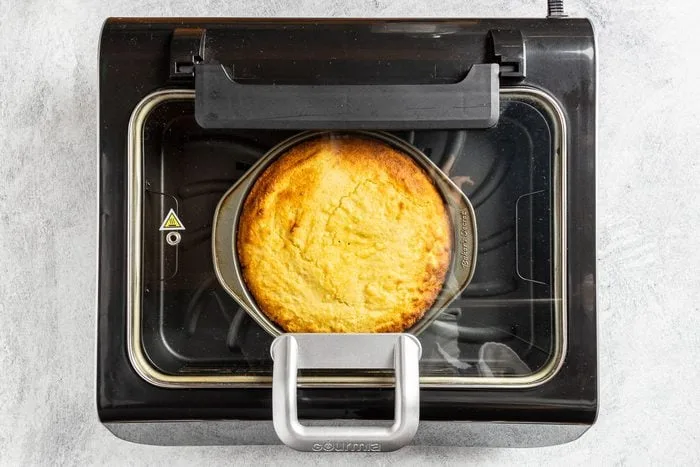
The Best Air Fryer Cornbread Recipe (Step-by-Step)
This recipe is designed for a standard 5 to 6-quart air fryer and uses a 6-inch cast iron skillet or similarly sized oven-safe pan. It yields 4 to 6 servings.
Ingredients
- 1 cup yellow cornmeal (medium grind)
- 1/2 cup all-purpose flour
- 1 tablespoon granulated sugar (omit for Southern-style)
- 1 teaspoon baking powder
- 1/2 teaspoon baking soda
- 1/2 teaspoon salt
- 1 large egg
- 3/4 cup buttermilk
- 3 tablespoons melted butter, plus more for greasing
- 1 tablespoon honey (optional)
Instructions
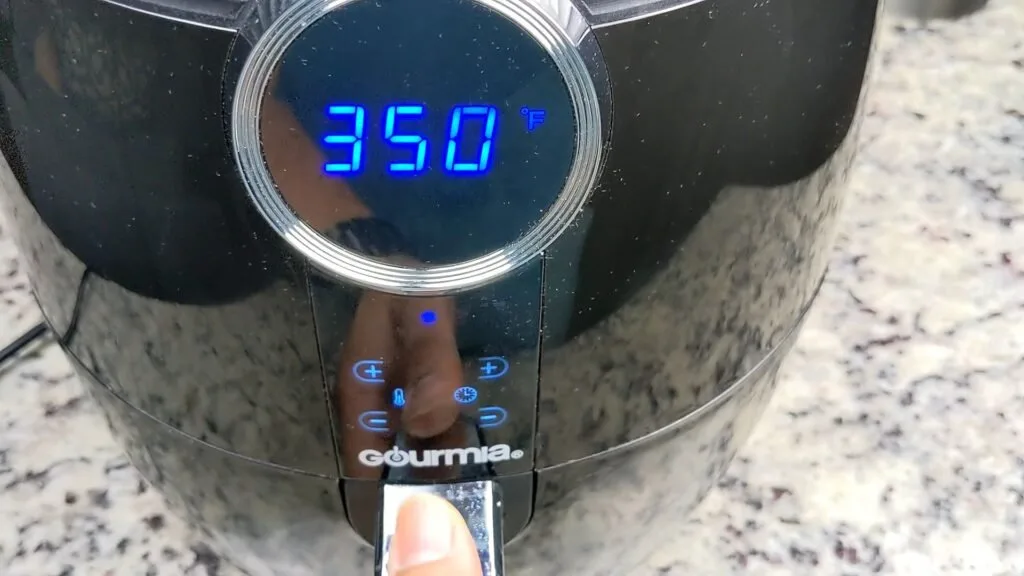
Preheat the air fryer to 350°F for 3 minutes. Not all models have a preheat function. If yours doesn't, simply run it empty at 350°F for 3 minutes.
Grease your pan generously with butter or cooking spray. A 6-inch cast iron skillet works best. Ramekins also work for individual portions.
Mix the dry ingredients. Whisk together the cornmeal, flour, sugar, baking powder, baking soda, and salt in a medium bowl.
Mix the wet ingredients. In a separate bowl, whisk the egg, buttermilk, melted butter, and honey until smooth.
Combine wet and dry. Pour the wet mixture into the dry ingredients. Stir until just combined. Do not overmix. A few small lumps are fine. Overmixing develops gluten and makes the cornbread tough.
Pour the batter into the greased pan. Fill it no more than three-quarters full. The cornbread will rise during cooking.
Place the pan in the air fryer basket. Make sure there's at least an inch of space around the pan for airflow. If the pan touches the sides of the basket, heat distribution will be uneven.
Cook at 350°F for 14 to 18 minutes. Start checking at 12 minutes. The cornbread is done when the top is golden brown and a toothpick inserted in the center comes out clean or with just a few moist crumbs.
Let it cool in the pan for 3 to 5 minutes before slicing. This allows the crumb to set so it doesn't fall apart when you cut it.
Cook Time and Temperature Guide
| Air Fryer Size | Temperature | Cook Time | Pan Size |
|---|---|---|---|
| 3.5 to 4 qt | 350°F | 16 to 20 min | 5-inch skillet or ramekins |
| 5 to 6 qt | 350°F | 14 to 18 min | 6-inch cast iron skillet |
| 8 to 9 qt | 340°F | 12 to 16 min | 6-inch skillet (more airflow) |
Larger air fryers with more powerful fans cook faster. If you're using an 8-quart model, reduce the temperature by 10°F and check a couple of minutes earlier.
Ingredients You'll Need (and Why Each One Matters)
Every ingredient in cornbread has a specific job. Understanding what each one does helps you troubleshoot problems and make substitutions with confidence.
Cornmeal is the star. It provides the characteristic gritty texture and corn flavor. Medium grind is the best all-purpose choice.
Fine grind produces a softer, more cake-like crumb. Coarse grind gives a crunchier, more rustic texture. Yellow cornmeal is the most common in the United States, though white cornmeal is traditional in some Southern recipes.
All-purpose flour adds structure. Cornmeal alone doesn't have enough gluten to hold the bread together. The flour provides that binding.
A 2-to-1 ratio of cornmeal to flour is the standard balance between corn flavor and structural integrity.
Buttermilk is the liquid base and the acid that activates baking soda. Its tanginess is a defining flavor in traditional cornbread. If you don't have buttermilk, add 1 tablespoon of white vinegar or lemon juice to 3/4 cup of regular milk and let it sit for 5 minutes.
This homemade substitute works nearly as well.
Egg acts as a binder and adds moisture. One large egg is standard for this batch size. For a vegan version, a flax egg (1 tablespoon ground flaxseed mixed with 3 tablespoons water, rested for 5 minutes) is a reliable substitute.
Butter adds richness and flavor. Melted butter is mixed into the batter, and additional butter is used to grease the pan. Bacon grease is a traditional Southern alternative that adds a savory, smoky depth.
Baking powder and baking soda are the leavening agents. Baking powder provides the primary rise. Baking soda reacts with the acid in buttermilk to create additional lift and tenderness.
Using both produces a better rise than either one alone.
Sugar is the dividing line between Northern and Southern cornbread. Northern-style cornbread typically includes 1 to 2 tablespoons of sugar for a slightly sweet flavor. Southern-style cornbread traditionally omits sugar entirely.
This is a matter of regional pride as much as taste.
Salt enhances all the other flavors. Without it, cornbread tastes flat and one-dimensional.
Choosing the Right Pan for Your Air Fryer
The pan you use matters as much as the recipe itself. Air fryers rely on airflow, and the wrong pan can block that airflow, leading to uneven cooking or a soggy bottom.
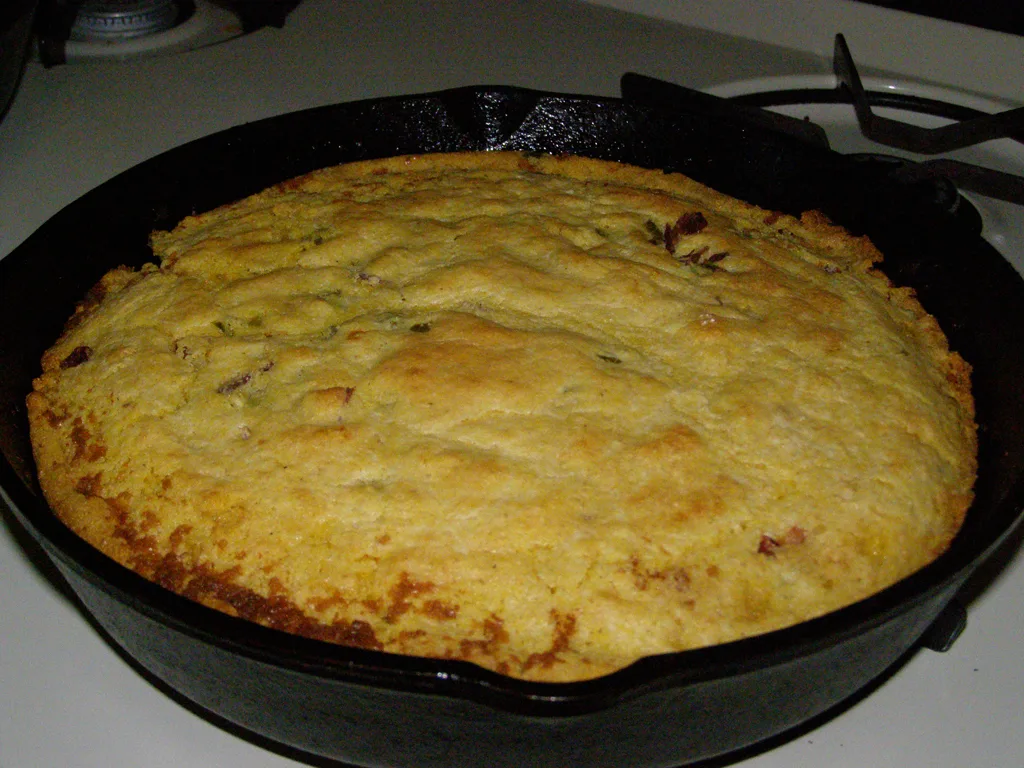
Cast iron skillets are the top choice. A 6-inch pre-seasoned cast iron skillet fits most standard air fryers and retains heat exceptionally well. The pre-seasoned surface is naturally non-stick when properly greased.
Cast iron also contributes to a crispier bottom crust because it holds and distributes heat more evenly than thin metal pans.
Ramekins are great for individual portions. Standard 7-ounce ceramic ramekins work well. They're easy to grease, and the portion-controlled size means everyone gets their own perfectly cooked piece.
Four ramekins typically fit in a 5 to 6-quart basket.
Silicone baking cups are another option. They're flexible, non-stick, and easy to clean. However, they don't conduct heat as well as cast iron, so the bottom crust won't be as crispy.
Parchment liners with perforations can be placed under the pan to catch drips without blocking airflow. Never use a solid sheet of aluminum foil at the bottom of the basket. It blocks the air circulation that makes air frying work.
What to Avoid
- Glass pans that aren't rated for high heat. Some glass dishes can crack under the intense, direct heat of an air fryer.
- Oversized pans that leave less than an inch of clearance around the edges. This restricts airflow and causes uneven cooking.
- Non-stick pans with damaged coatings. Flaking non-stick surfaces can contaminate food at high temperatures.
Before you start, always check your air fryer manufacturer's guidelines for approved accessories. Some brands, like Instant Vortex, sell specifically designed baking pans that fit their baskets perfectly.
How to Prevent Dry, Crumbly Cornbread
Dry cornbread is the number one complaint in air fryer baking. The high heat and constant airflow that create a great crust can also pull moisture out of the batter faster than a conventional oven would. Here's how to fight back.
Don't overbake. Start checking your cornbread at 10 to 12 minutes, even if the recipe says 18. Every air fryer runs slightly differently. A toothpick inserted in the center should come out with a few moist crumbs clinging to it.
If it's completely dry, you've gone too far.
Use buttermilk, not regular milk. The fat and acidity in buttermilk help retain moisture during cooking. Regular milk works in a pinch, but the results won't be as tender.
Add an extra tablespoon of fat. If your cornbread keeps coming out dry, increase the melted butter from 3 tablespoons to 4, or add a tablespoon of sour cream or plain yogurt to the wet ingredients. The additional fat coats the starch molecules and slows moisture loss.
Cover with foil halfway through. If the top is browning too fast but the center isn't set, loosely tent a small piece of aluminum foil over the pan for the remaining cook time. This slows surface browning while the center finishes cooking.
Let it rest before cutting. Cutting into cornbread immediately after it comes out of the air fryer releases steam that the crumb needs to set. Waiting 3 to 5 minutes makes a noticeable difference in moisture retention.
Store it properly. If you have leftovers, wrap the cornbread tightly in plastic wrap or store it in an airtight container. It stays moist at room temperature for up to 2 days, or in the refrigerator for up to 5 days. Reheat slices in the air fryer at 300°F for 2 to 3 minutes to restore the crust.
One more tip: if you're using a larger air fryer, the increased airflow can dry out smaller batches faster. Reduce the temperature by 10°F and keep a close eye on the cornbread after the 10-minute mark.
Sweet vs. Savory Cornbread: Which Style Works Best in an Air Fryer?
This is one of the great debates in American cooking, and the air fryer doesn't change the fundamentals. Both styles work well. The choice comes down to personal preference and what you're serving it with.
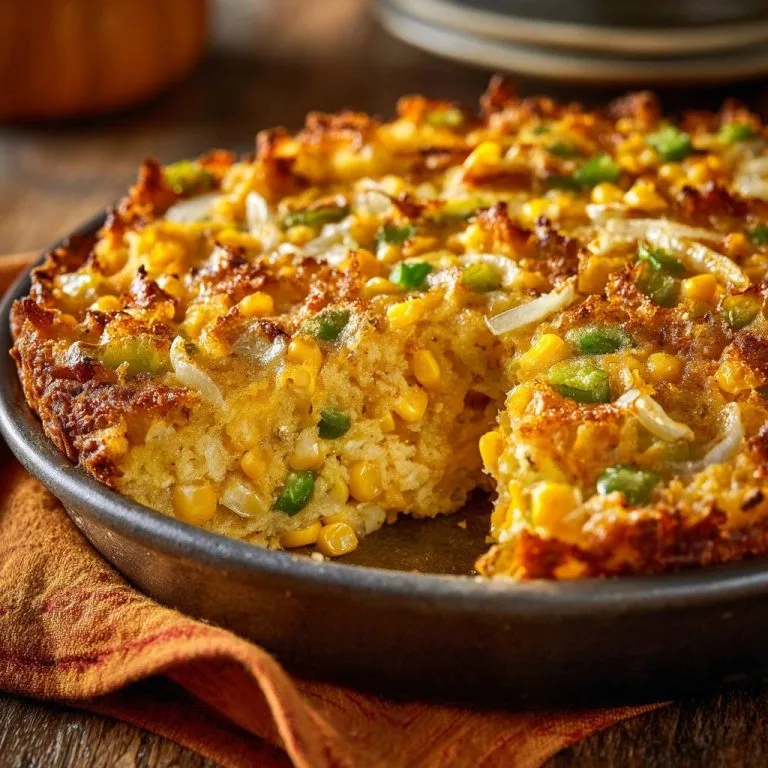
Northern-style (sweet) cornbread includes sugar or honey, sometimes up to 1/4 cup. It's softer, more cake-like, and pairs well with butter and honey as a standalone snack. The added sugar also promotes browning, which can be an advantage in the air fryer since the crust develops faster.
Southern-style (savory) cornbread skips the sugar entirely. It relies on the natural flavor of cornmeal, often uses bacon grease instead of butter, and has a crumblier, more rustic texture. This is the traditional side dish for chili, collard greens, and barbecue.
Which Works Better in an Air Fryer?
Honestly, both work great. But there's a slight edge to savory cornbread in the air fryer. Here's why: the sugar in sweet cornbread caramelizes faster under high heat.
In an air fryer, that can mean the top browns before the center is fully set. You can manage this by lowering the temperature to 340°F and adding a couple of minutes to the cook time.
Savory cornbread is more forgiving. Without sugar, there's less risk of the surface over-browning. The simpler ingredient list also means fewer variables that can go wrong.
A Quick Comparison
| Feature | Sweet (Northern) | Savory (Southern) |
|---|---|---|
| Sugar | 1 to 2 tablespoons | None |
| Fat | Butter | Butter or bacon grease |
| Texture | Softer, cake-like | Crumblier, rustic |
| Best pairings | Honey butter, jam | Chili, greens, BBQ |
| Air fryer tip | Lower temp to 340°F | Standard 350°F works fine |
If you're new to air fryer cornbread, start with the savory version. It's more forgiving and gives you a feel for how your specific air fryer handles batter-based recipes. Once you've dialed in the timing, experiment with the sweet variation.
Common Mistakes That Ruin Air Fryer Cornbread
Even a straightforward recipe can go wrong if you overlook a few key details. These are the mistakes we see most often in user reviews and recipe feedback.
Skipping the preheat. An air fryer that hasn't reached full temperature will produce unevenly cooked cornbread. The outside sets too slowly, and the center can end up dense or gummy. Always preheat for at least 3 minutes.
Overmixing the batter. Cornbread batter should be stirred until the dry ingredients are just incorporated. A few lumps are fine. Overmixing develops gluten from the flour, which makes the cornbread tough and chewy instead of tender and crumbly.
Using the wrong pan size. A pan that's too large leaves no room for airflow. A pan that's too small means the batter is too deep and won't cook through. A 6-inch skillet is the sweet spot for most air fryers.
Filling the pan too full. Batter rises during cooking. If you fill the pan to the top, it will overflow and make a mess in your basket. Fill it no more than three-quarters full.
Not greasing the pan enough. Cornbread sticks aggressively to ungreased surfaces. Use a generous amount of butter, oil, or cooking spray on the bottom and sides of the pan.
Setting the temperature too high. 400°F might seem like it'll cook faster, but it'll burn the outside before the inside is done. 350°F is the standard. For larger air fryers with stronger fans, 340°F is even better.
Opening the basket too often. Every time you pull the basket out, you lose heat and disrupt the cooking environment. Check once at the 12-minute mark. That's usually enough.
Ignoring your air fryer's quirks. Every model is slightly different. A dual-basket air fryer may cook differently than a single-basket model. Learn your machine's tendencies and adjust accordingly.
How to Tell When Your Cornbread Is Actually Done
Underbaked cornbread is gummy in the center. Overbaked cornbread is dry and crumbly. The window between the two is narrower in an air fryer than in a conventional oven, so knowing what to look for matters.
The toothpick test is the most reliable method. Insert a wooden toothpick or cake tester into the center of the cornbread. If it comes out clean or with just a few moist crumbs, it's done.
If wet batter clings to it, give it another 2 to 3 minutes and test again.
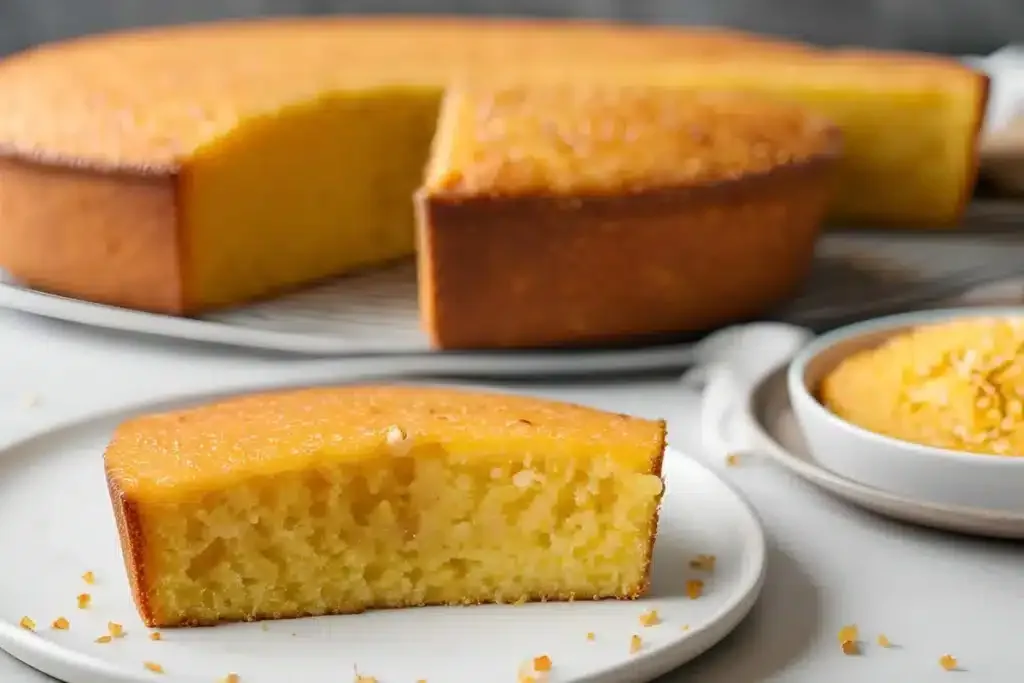
Visual cues help too. The top should be evenly golden brown, and the edges should pull slightly away from the sides of the pan. The surface should spring back when gently pressed with a fingertip.
If it feels soft or sinks under light pressure, it needs more time.
An instant-read thermometer removes all guesswork. Cornbread is fully cooked when the internal temperature reaches 200°F to 205°F, per USDA guidelines for baked goods. Insert the probe into the center, avoiding the pan bottom.
One important note: carryover cooking is real. The cornbread will continue to cook from residual heat for a few minutes after you pull it from the basket. If the toothpick shows just a tiny bit of moisture at the 16-minute mark, take it out.
It'll finish setting as it rests.
Air Fryer Cornbread vs. Oven Cornbread: Real Differences
Both methods produce good cornbread. But the differences are real, and they affect texture, flavor, and convenience in ways that might sway your decision.
Texture is the biggest difference. Air fryer cornbread develops a noticeably crispier crust on all exposed surfaces because the circulating air constantly removes moisture. The interior tends to be slightly denser since the batter sets faster, giving the crumb less time to rise and aerate.
Oven cornbread has a more uniform texture throughout, with a softer crust and a lighter, more open crumb.
Flavor is similar but not identical. The faster cook time in an air fryer means slightly less caramelization of the sugars in the batter. Oven-baked cornbread develops a deeper, more toasty corn flavor during the longer bake.
For recipes with added sugar or honey, this difference is more noticeable.
Cook time favors the air fryer decisively. An air fryer batch is done in 12 to 18 minutes, plus a 3-minute preheat. An oven batch requires 10 to 15 minutes of preheating and 25 to 35 minutes of baking.
That's a total of 15 to 21 minutes versus 35 to 50 minutes.
Batch size favors the oven. A standard oven can handle a full 10-inch skillet or a 9×9 baking pan. Most air fryers max out at a 6-inch skillet or four ramekins.
If you're cooking for a crowd, the oven is still the better tool. For a big family, consider making two sequential air fryer batches.
| Factor | Air Fryer | Conventional Oven |
|---|---|---|
| Total time | 15 to 21 min | 35 to 50 min |
| Crust | Crispier, all around | Softer, top only |
| Interior | Slightly denser | Lighter, more open |
| Batch size | Small (4 to 6 servings) | Large (8 to 12 servings) |
| Energy use | 1,200 to 1,800W | 2,000 to 5,000W |
| Kitchen heat | Minimal | Significant |
Easy Variations: Jalapeño, Honey Butter, and Gluten-Free
Once you've mastered the base recipe, small tweaks can take it in completely different directions. These three variations are the most popular in user-submitted recipes and forum discussions.
Jalapeño cheddar cornbread is the crowd-pleaser. Fold 1/2 cup of shredded sharp cheddar and 2 tablespoons of diced fresh jalapeños into the batter at the end of mixing. The fat from the cheese adds moisture, which helps offset the drying effect of the air fryer.
Reduce the cook temperature to 340°F since the extra ingredients add density.
Honey butter cornbread leans sweet. Add 2 tablespoons of honey to the wet ingredients and increase the sugar to 2 tablespoons. After the cornbread comes out of the air fryer, brush the top with a mixture of 2 tablespoons melted butter and 1 tablespoon honey while it's still warm.
The glaze soaks in and creates an incredibly moist, rich top layer.
Gluten-free cornbread swaps the all-purpose flour for a 1-to-1 gluten-free baking flour blend. Look for one that contains xanthan gum, which replaces the binding function of gluten. Bob's Red Mill and King Arthur both make reliable blends.
The texture will be slightly more crumbly, but the flavor is nearly identical. Add an extra tablespoon of buttermilk to compensate for the absorbency of GF flours.
For a vegan version, replace the egg with a flax egg, use plant-based milk with vinegar instead of buttermilk, and substitute coconut oil for butter. The results are surprisingly close to the original.
How to Reheat Leftover Cornbread in the Air Fryer
Reheating cornbread in an air fryer is arguably better than reheating it in a microwave. The microwave steams the crumb and makes it soggy. The air fryer restores the crust and warms the interior without adding moisture.
Cut the leftover cornbread into slices or wedges. Place them directly in the air fryer basket, or on a small piece of parchment paper if you're worried about crumbs falling through.
Set the temperature to 300°F. Heat for 2 to 3 minutes. The outside should feel warm and slightly crisp, and the interior should be soft all the way through.
Don't go higher than 325°F for reheating. The sugars in the cornbread will burn before the center warms up.
If the cornbread seems dry after storage, brush the tops with a thin layer of melted butter before reheating. The butter soaks in during warming and restores much of the original moisture.
This method works for all the variations mentioned above. Jalapeño cheddar slices actually taste better the second day, since the flavors have had time to meld.
Expert Tips for Perfect Results Every Time
These are the small details that separate good air fryer cornbread from great air fryer cornbread. They come from aggregate user feedback across multiple air fryer communities and recipe platforms.
Weigh your cornmeal. A cup of cornmeal can vary from 120 to 160 grams depending on how you scoop it. Inconsistent measurements are the most common cause of texture problems. A small kitchen scale costs under $10 and eliminates the guesswork.
Let the batter rest for 5 minutes before pouring. This allows the cornmeal to hydrate and the leavening agents to start activating. The result is a more even rise and a more tender crumb.
Rotate the pan halfway through cooking. Most air fryer baskets have a hot spot on the side closest to the heating element. Turning the pan 180 degrees at the halfway mark ensures even browning.
Use room-temperature ingredients. Cold eggs and buttermilk don't emulsify as smoothly, which can lead to a slightly grainy texture. Pull them out of the fridge 20 to 30 minutes before you start.
Don't skip the salt. Even in sweet cornbread, salt is essential. It amplifies the corn flavor and balances the sugar. Without it, the cornbread tastes flat no matter how good your other ingredients are.
Experiment with your specific machine. Air fryers vary more than ovens in terms of heat distribution and airflow intensity. Make the recipe once as written, then adjust time and temperature by small increments based on your results. Write down what works.
After two or three batches, you'll have a recipe dialed in for your exact setup.
If you're looking for more air fryer recipes to round out your cooking rotation, our air fryer banana chips recipe is another quick win that uses the same principles of high heat and fast cook times.
Frequently Asked Questions
Can I use Jiffy cornbread mix in an air fryer?
Yes. One 8.5-ounce box of Jiffy cornbread mix works perfectly. Prepare the batter according to the package directions, pour it into a greased 6-inch skillet, and cook at 350°F for 14 to 16 minutes.
The toothpick test still applies.
Do I need to preheat my air fryer for cornbread?
Preheating is strongly recommended. Three minutes at your target temperature ensures the batter starts cooking immediately. Without preheating, the center can end up dense while the edges over-brown.
Why did my cornbread overflow the pan?
The pan was too full or too small. Batter rises during cooking, so fill the pan no more than three-quarters full. If overflow keeps happening, switch to a slightly larger pan or divide the batter between two ramekins.
Can I make cornbread muffins in an air fryer?
Absolutely. Use silicone baking cups or greased ramekins. Fill each one half full and cook at 340°F for 10 to 13 minutes.
The smaller size means faster cooking, so check early.
How do I keep cornbread from sticking to the pan?
Grease the pan generously with butter, oil, or cooking spray on the bottom and all sides. For cast iron, make sure the seasoning is intact before you start. Let the cornbread cool for 3 to 5 minutes before attempting to remove it.
Is air fryer cornbread healthy?
Cornbread is a moderate-calorie side dish. A typical serving from this recipe runs about 180 to 220 calories. Using buttermilk and butter contributes saturated fat, but the portion size is small.
For a lighter version, reduce the butter by one tablespoon and use low-fat buttermilk.