
Store-bought beef jerky costs anywhere from $20 to $40 per pound and is loaded with preservatives you can't control. The best air fryer beef jerky recipe gives you full control over ingredients, sodium levels, and flavor, and it costs roughly $8 to $12 per pound at home. You probably already own the only appliance you need.
In our research, we found that air fryer jerky takes 2 to 4 hours compared to 4 to 8 hours in a traditional dehydrator, and aggregate user reviews consistently report better texture control with the air fryer method. The USDA Food Safety and Inspection Service (FSIS) recommends heating beef to an internal temperature of 160°F (71°C) before or during drying to eliminate pathogens, which makes temperature accuracy critical. Here's everything you need to get it right.
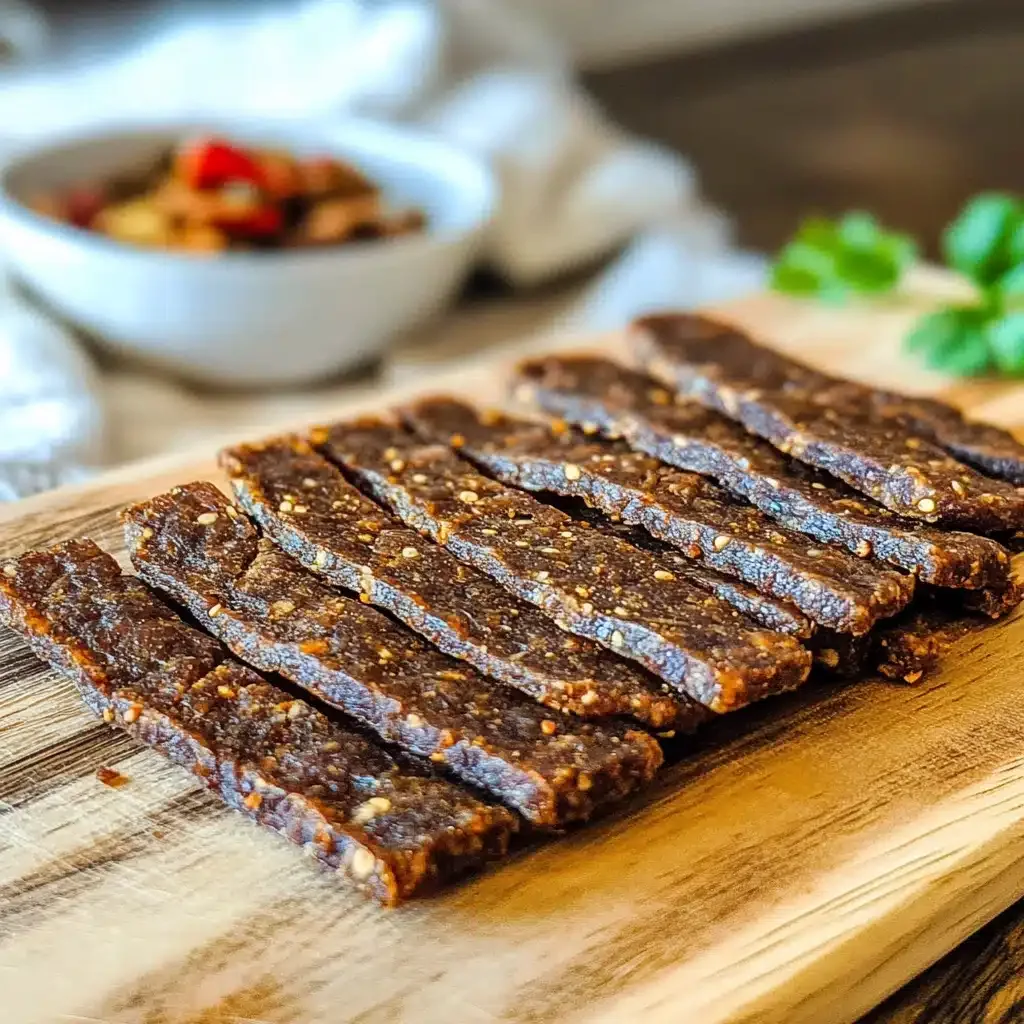
Image source: Bing (Web (fair-use with source credit))
Quick Answer
The best air fryer beef jerky recipe uses lean top round sliced 1/8 to 1/4 inch thick. Marinate the strips for at least 4 hours in a soy sauce and Worcestershire base. Dry at 160°F to 175°F for 2 to 4 hours with adequate airflow between strips.
The jerky is done when it bends and cracks but does not snap in half.
Why Air Fryer Jerky Is Worth Making at Home
Homemade jerky costs less than half of what you pay at the grocery store. You also get to skip the sodium nitrite, excess sugar, and mystery ingredients that fill most commercial bags.
Air fryers circulate hot air efficiently, which means faster and more even drying than most oven methods. A standard dehydrator takes 4 to 8 hours. Most air fryer batches finish in 2 to 4 hours.
You don't need to buy a separate appliance either. If you already own an air fryer, you're ready to go. For large families or anyone who meal preps snacks in bulk, pairing this method with a high-capacity unit like a 9 qt air fryer for large batches makes the process even more practical.
Choosing the Right Cut of Beef for Jerky
Fat is the enemy of good jerky. It doesn't dry out properly, it turns rancid faster, and it shortens shelf life significantly. You want the leanest cut you can find.
Top round is the most popular choice. It's widely available, affordable, and has very little intramuscular fat. Bottom round and eye of round work well too.
Flank steak produces a slightly more tender result but costs more per pound.
Best cuts for beef jerky:
- Top round (most recommended)
- Bottom round
- Eye of round
- Sirloin tip
- Flank steak (premium option)
Avoid ribeye, chuck, or any well-marbled cut. The fat content is too high for safe drying. If you're unsure what to ask for at the butcher counter, just say you need a lean roast for dehydrating.
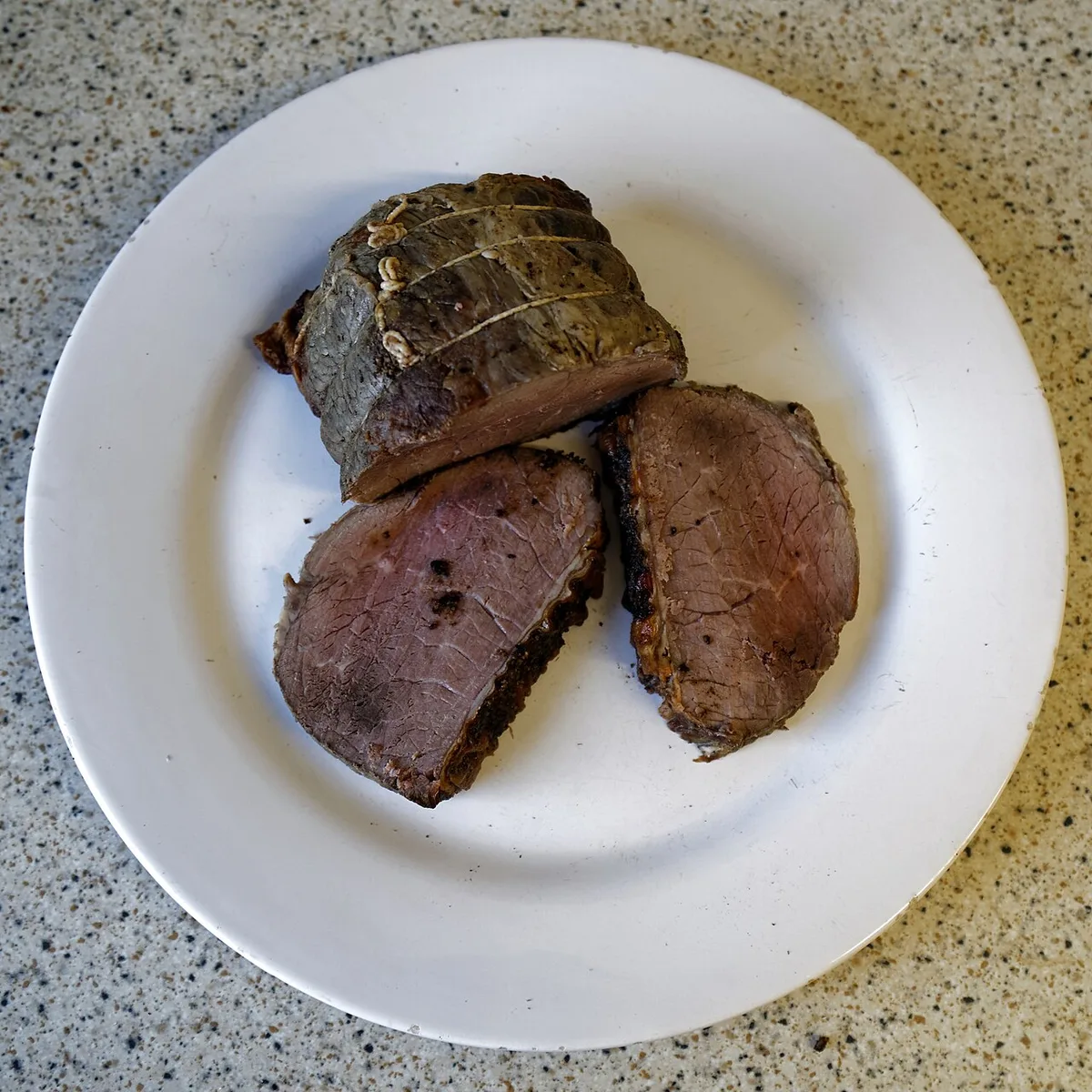
Image source: Wikimedia Commons / Acabashi (CC BY-SA)
How to Prepare and Slice Meat for the Best Texture
Slice thickness determines your final texture. Thinner strips dry faster and come out crispier. Thicker strips stay chewy and take longer.
Aim for 1/8 inch if you like a snappier jerky. Go up to 1/4 inch for a chewier, more traditional bite. The key is consistency.
Uneven strips mean some pieces over-dry while others stay under-done.
Put the meat in the freezer for 30 to 60 minutes before slicing. A partially frozen roast holds its shape and cuts much more cleanly than a fully thawed one. Use a sharp chef's knife and work slowly.
You can slice with the grain for a tougher, stringier chew or against the grain for a more tender bite that breaks apart easily. Most people prefer against the grain. Trim off every bit of visible fat before you start marinating.
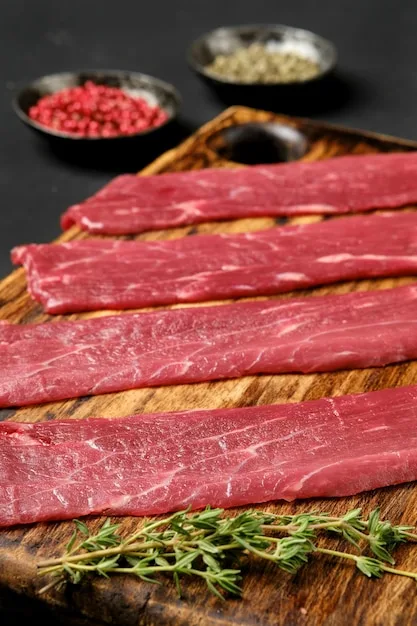
Image source: Bing (Web (fair-use with source credit))
The Best Marinade for Air Fryer Jerky (With Recipe)
A good jerky marinade needs three things: salt, umami, and a touch of sweetness. The salt preserves and seasons. The umami builds depth.
The sweetness balances everything out.
This recipe makes enough marinade for about 1.5 pounds of beef.
Ingredients:
- 1/2 cup soy sauce (or tamari for gluten-free)
- 2 tablespoons Worcestershire sauce
- 1 tablespoon liquid smoke
- 1 tablespoon brown sugar or honey
- 1 teaspoon garlic powder
- 1 teaspoon onion powder
- 1 teaspoon smoked paprika
- 1/2 teaspoon black pepper
- 1/2 teaspoon cayenne pepper (optional)
Whisk everything together in a bowl. Add the beef strips, making sure every piece is coated. Seal in a zip-lock bag or covered container and refrigerate for at least 4 hours.
Overnight, 12 to 24 hours, gives the best flavor penetration.
If you want a spicier jerky, bump the cayenne to a full teaspoon or add 1/2 teaspoon of crushed red pepper flakes. For a sweeter profile, increase the brown sugar to 2 tablespoons.
Image source: Bing (Web (fair-use with source credit))
Which Air Fryers Actually Work for Jerky
Not every air fryer can do jerky well. The problem is temperature. Jerky needs to dry at 160°F to 175°F.
Many air fryers have a minimum temperature of 180°F or higher, which cooks the outside before the inside dries.
Look for a model with a dedicated dehydrate mode. The Ninja Foodi, certain Cosori models, and the Breville Smart Oven Air all offer low-temperature settings that work for jerky. The Instant Vortex line is popular and affordable, though not all models go low enough.
Our research on whether the Instant Vortex air fryer is good covers the temperature ranges across different sizes.
What to look for:
- Dehydrate mode or temperature settings as low as 160°F
- Multiple rack layers for batch capacity
- Mesh or perforated trays for airflow underneath
- At least 5-quart capacity for reasonable batch sizes
If your air fryer only goes down to 200°F, you can still make jerky, but you'll need to prop the door open slightly with a wooden spoon to let moisture escape. It's not ideal, but it works in a pinch.
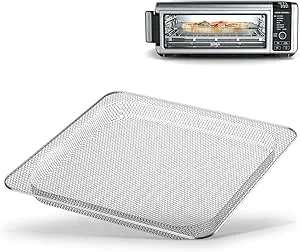
Image source: Bing (Web (fair-use with source credit))
Step-by-Step: How to Make Beef Jerky in an Air Fryer
Once your meat has marinated and you've confirmed your air fryer can hit the right temperature, the process is straightforward.
Step 1: Remove the strips from the marinade and pat them dry with paper towels. Excess moisture slows down drying and leads to uneven results.
Step 2: Arrange the strips in a single layer on the air fryer tray. Leave at least 1/4 inch of space between each piece. Overcrowding blocks airflow and causes steaming instead of drying.
Step 3: Set the temperature to 160°F to 175°F. If your air fryer uses a dehydrate mode, select that. If not, use the lowest available temperature setting.
Step 4: Cook for 2 to 4 hours. Flip the strips halfway through. Thinner slices at 175°F may finish in closer to 2 hours.
Thicker cuts at 160°F can take the full 4 hours.
Step 5: Check for doneness. The jerky should bend and show small cracks on the surface without snapping in half. There should be no visible moisture or raw color in the center.
Step 6: Let the jerky cool completely on a wire rack before storing. This prevents condensation inside the container, which leads to mold.
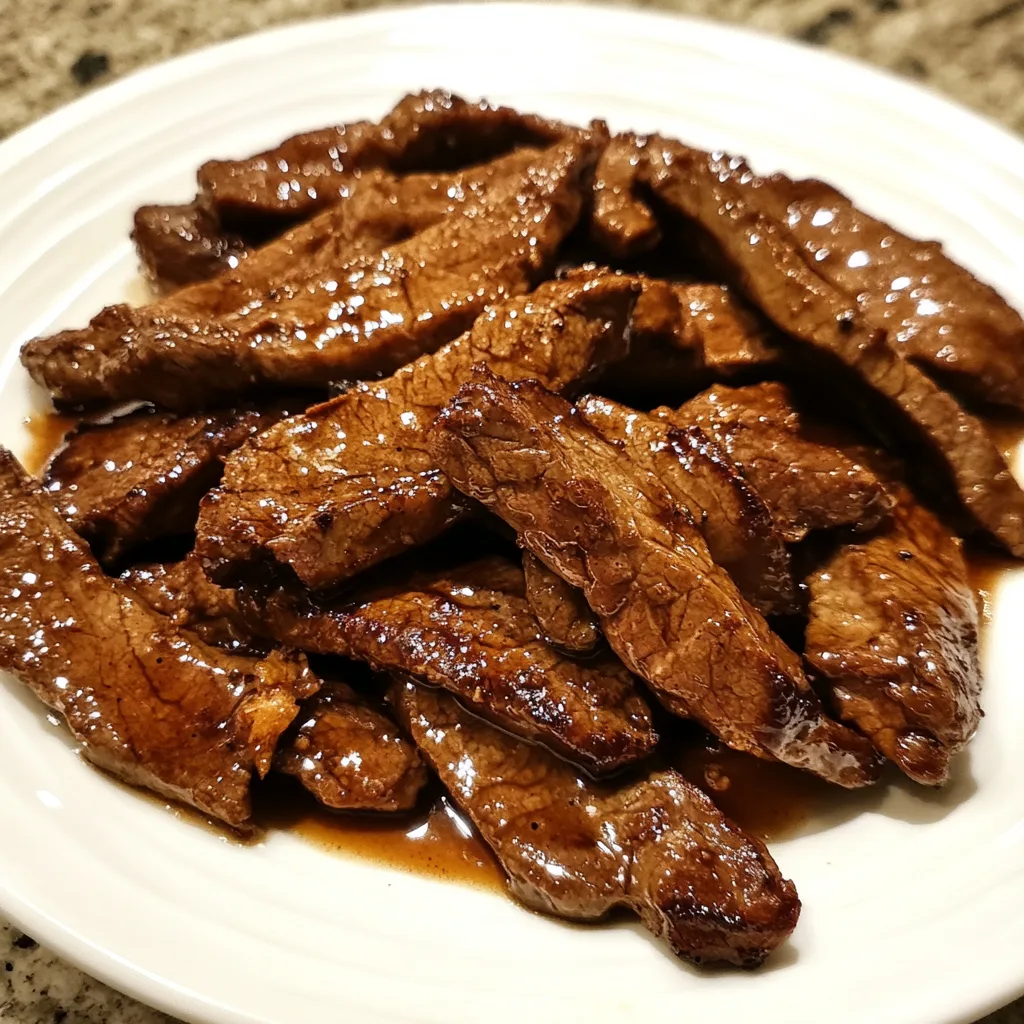
Image source: Bing (Web (fair-use with source credit))
How to Tell When Your Jerky Is Done
Under-dried jerky spoils quickly. Over-dried jerky is brittle and unpleasant. The sweet spot is a piece that flexes and cracks but doesn't break.
Pick up a strip and bend it gently. Properly dried jerky will show white fibrous cracks along the bend line. If it feels soft and pliable with no cracking, it needs more time.
If it snaps clean in half, you've gone too long.
Cut a piece in half and check the center. It should be uniformly dried with no darker, moist spots. If the outside feels done but the inside looks raw, return the batch for another 30 to 60 minutes.
Let a test strip cool for 5 minutes before judging. Jerky firms up as it cools, so a piece that feels slightly soft when warm may be perfect once it reaches room temperature.
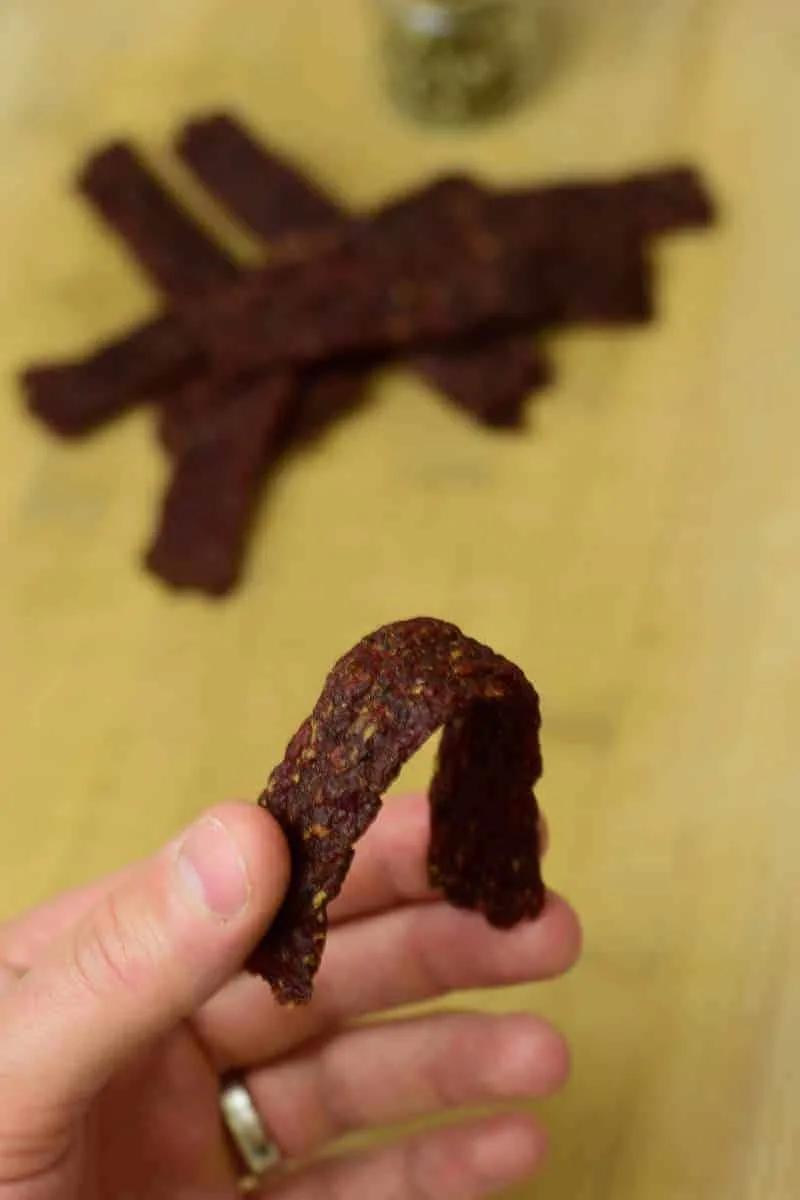
Image source: Bing (Web (fair-use with source credit))
Common Mistakes That Ruin Air Fryer Jerky
The most common error is overcrowding the tray. When strips overlap or touch, moisture gets trapped between them. You end up with steamed, uneven jerky instead of properly dried meat.
Skipping the pat-down step is another frequent mistake. Wet strips take significantly longer to dry and develop a tacky surface that never fully cures.
Using a fatty cut of beef causes spoilage within days. Even if the jerky looks and tastes fine at first, the residual fat turns rancid fast. Always trim thoroughly.
Running the temperature too high is the fastest way to ruin a batch. The outside seals into a hard shell while the inside stays moist. This is called case hardening, and it traps moisture inside the meat where bacteria can grow.
Storing jerky before it's fully cooled creates condensation inside the container. That moisture invites mold. Always let it cool to room temperature first.
Storing Jerky to Keep It Fresh and Safe
Properly dried beef jerky lasts 1 to 2 months at room temperature in an airtight container. Refrigeration extends that to 6 months or more. Vacuum sealing gives you the longest shelf life.
Storage options ranked by shelf life:
| Method | Shelf Life | Best For |
|---|---|---|
| Airtight container, room temp | 1 to 2 months | Daily snacking |
| Refrigerated in sealed bag | 3 to 6 months | Weekly batch prep |
| Vacuum sealed, room temp | 3 to 6 months | Bulk storage |
| Vacuum sealed, frozen | 12+ months | Long-term storage |
Add a small food-safe silica gel packet to the container to absorb any residual moisture. This is especially helpful in humid climates.
If you notice any off smell, slimy texture, or visible mold, discard the entire batch. Don't taste-test questionable jerky.
Ground Beef Jerky vs. Whole Muscle: Which Should You Make
Whole muscle jerky is sliced from a single cut of beef. It has a traditional, fibrous texture and shows the natural grain of the meat. Ground beef jerky is made by extruding seasoned ground meat through a jerky gun into uniform strips, then drying them.
Ground beef jerky is easier for beginners. You don't need to worry about slicing technique or finding the perfect cut. It also accepts seasoning more evenly since the meat is mixed before shaping.
Whole muscle jerky has a more authentic chew and a look that closely matches store-bought jerky. It's the better choice if you want that classic jerky experience.
Key differences:
| Factor | Whole Muscle | Ground Beef |
|---|---|---|
| Texture | Fibrous, traditional | Uniform, slightly softer |
| Prep difficulty | Moderate (slicing required) | Easy (jerky gun) |
| Fat control | Manual trimming | Choose lean ground beef |
| Appearance | Natural meat grain | Uniform strips |
| Cost per pound | $8 to $12 | $6 to $10 |
For ground beef, use 90/10 or 93/7 lean-to-fat ratio. Anything fatter won't dry properly.
Air Fryer vs. Dehydrator vs. Oven: Which Method Wins
Each method works, but they produce slightly different results. The air fryer strikes the best balance between speed and quality for most home cooks.
A dedicated food dehydrator offers the most precise temperature control and the largest batch capacity. It's the gold standard for serious jerky makers. But it's another appliance to store, and it's slow.
Most runs take 4 to 8 hours.
The oven method works in a pinch, but most ovens don't go below 170°F, and the lack of strong air circulation leads to uneven drying. You'll need to prop the door open and rotate trays frequently.
The air fryer's forced convection dries meat faster and more evenly than an oven. The trade-off is smaller batch capacity.
Comparison at a glance:
| Method | Time | Temp Control | Batch Size | Ease |
|---|---|---|---|---|
| Air fryer | 2 to 4 hours | Good (if dehydrate mode) | Small to medium | High |
| Dehydrator | 4 to 8 hours | Excellent | Large | High |
| Oven | 3 to 4 hours | Poor to fair | Medium | Medium |
If you're making jerky regularly, a dehydrator is worth the investment. For occasional batches, the air fryer is the smarter choice.
Expert Tips for Better Jerky Every Time
Add 1 teaspoon of curing salt (Prague Powder #1) to your marinade if you want extended shelf life and that pink-red color you see in commercial jerky. It's optional for short-term storage but recommended if you plan to keep jerky for more than a month.
Rotate your trays if your air fryer has hot spots. Most units circulate air from one direction, so the strips closest to the fan dry faster. Swapping top and bottom racks halfway through evens things out.
Don't skip the liquid smoke. Since you're not actually smoking the meat, liquid smoke is what gives jerky that campfire flavor people expect. Hickory and mesquite are the most popular varieties.
If your strips curl during drying, score the meat lightly with a knife before marinating. Two or three shallow cuts along each strip help it lay flat and dry evenly.
For a teriyaki-style jerky, swap the Worcestershire for pineapple juice and add 1 tablespoon of rice vinegar. The acid in the pineapple juice also helps tenderize the meat slightly.
Safety Rules You Can't Skip When Making Jerky at Home
The USDA FSIS requires that beef jerky reach an internal temperature of 160°F (71°C) to destroy harmful bacteria including E. coli and Salmonella. This is not optional.
There are two ways to meet this requirement. You can heat the strips in your marinade on the stovetop to 160°F before transferring them to the air fryer. Or you can run the air fryer at a temperature that brings the meat to 160°F during the drying process, which most air fryers at 175°F will achieve within the first hour.
Use an instant-read meat thermometer to verify. Stick the probe into the thickest part of a test strip. If it reads below 160°F, continue drying and check again in 30 minutes.
Keep everything cold before and during marination. Bacteria multiply rapidly between 40°F and 140°F. Never leave marinating meat on the counter.
Always refrigerate.
Wash your hands, cutting board, and knives thoroughly after handling raw meat. Cross-contamination is one of the most common causes of foodborne illness in home kitchens.
If you're immunocompromised, pregnant, or serving jerky to young children, consider using curing salt and strictly following USDA protocols. The margin for error is smaller for vulnerable populations.
Frequently Asked Questions
Can I make jerky in an air fryer without a dehydrate mode?
Yes, but you need to use the lowest temperature setting available. If your air fryer's minimum is 200°F or higher, prop the door open slightly with a wooden spoon to release moisture and reduce the effective temperature. Monitor closely to avoid over-drying the outside before the inside cures.
How long does air fryer beef jerky last?
Properly dried and stored jerky lasts 1 to 2 months at room temperature in an airtight container. Refrigeration extends shelf life to 3 to 6 months. Vacuum sealing gives you the longest storage window.
What temperature should I set my air fryer for jerky?
Set your air fryer to 160°F to 175°F. If your unit has a dehydrate mode, use that. The goal is low, steady heat that dries the meat without cooking it.
Always verify the internal temperature reaches 160°F for food safety.
Can I use frozen beef to make jerky?
Start with fresh or thawed beef. Partially freezing the meat for 30 to 60 minutes before slicing makes it easier to cut thin, even strips. Never put frozen strips directly into the air fryer, as the outside will cook before the inside thaws and dries.
Why is my jerky chewy instead of crispy?
Chewy jerky usually means the slices were too thick or the drying time was too short. Try slicing thinner, 1/8 inch, and extending the drying time. You can also increase the temperature by 10°F if your air fryer allows finer control.
Is air fryer jerky healthy?
Homemade air fryer jerky is high in protein, roughly 15 grams per ounce, and you control exactly what goes into it. You can reduce sodium by using low-sodium soy sauce and skip added sugars entirely. It's a significantly cleaner snack than most commercial options.