
Cooking flank steak in an air fryer is one of the fastest ways to get a deeply browned, juicy result without firing up the grill or dirtying a pan. A solid air fryer flank steak recipe gives you a charred crust on the outside and a tender, pink center in under 15 minutes of cook time. The trick is nailing the temperature, the prep, and the slice.
Flank steak is lean and unforgiving, a few extra minutes and you're chewing leather. In our research, aggregate user reviews and manufacturer cooking guides consistently point to the same sweet spot: 400°F, an instant-read thermometer, and a thorough rest before slicing. Get those three things right and you'll never go back to guessing.
Quick Answer
An air fryer flank steak recipe cooks at 400°F for 8 to 14 minutes. Flip the steak halfway through. Pull it at 130°F internal for medium-rare.
Rest it 5 to 10 minutes, then slice thin against the grain.
Why Air Fryer Flank Steak Deserves a Spot in Your Weekly Rotation
Flank steak is one of the most flavorful cuts you can buy. It's lean, beefy, and takes on marinades better than almost any other cut. The problem is that it's easy to overcook, especially on a grill where flare-ups and hot spots are unpredictable.
An air fryer solves that. Rapid convection heat, like what you'd find in a commercial convection oven scaled to countertop size, gives you an even, aggressive sear without the guesswork of charcoal or gas, though the flavor profile won't be identical. Manufacturer specs from brands like Ninja and Cosori confirm that most 5 to 6 quart air fryers preheat in under 5 minutes and hold 400°F consistently.
That means less time waiting and more control over your result.
It's also a weeknight-friendly method. No outdoor setup, no stovetop smoke, no oven preheating for 20 minutes. You season the steak, drop it in the basket, flip once, and pull it when the thermometer says it's done.
For anyone juggling dinner after work or meal prepping protein for the week, this method, and especially an air fryer flank steak recipe, is hard to beat.
The Biggest Mistake People Make When Cooking Flank Steak in an Air Fryer
Overcooking is the number one problem. Flank steak is lean with very little intramuscular fat. That means it doesn't have the forgiving buffer of a ribeye or strip once you move past medium.
Once you push past that point, the muscle fibers tighten and squeeze out every bit of remaining moisture. The result is dry, tough, and disappointingly chewy no matter how good your marinade was.
The air fryer's speed works against you here. Because it cooks so efficiently, the window between perfect and overdone is extremely narrow. Aggregate user reviews across multiple air fryer cooking communities show the same pattern: people set a timer for 15 minutes at 400°F for flank steak and end up with well-done meat every time.
The fix is simple. Use an instant-read thermometer and pull the steak at 130°F to 135°F. Carryover cooking during the rest will bring it up another 5 to 10 degrees.
Skipping the rest is the second biggest mistake. If you slice into flank steak the second it comes out of the basket, all the juices that should stay in the meat run all over the cutting board instead. Five to 10 minutes of rest under a loose foil tent makes a noticeable difference in every bite.
What Makes Flank Steak Different From Other Cuts
Flank steak comes from the abdominal muscles of the cow, specifically the section known as the flank, located behind the plate and in front of the round. It's a hard-working muscle, which means it has long, dense muscle fibers and very little fat marbling. That's what gives it its intense beef flavor, but it's also what makes it tough if you cook it wrong.
The grain is the key thing to understand before starting any air fryer flank steak recipe. Grain refers to the direction the muscle fibers run. On a flank steak, these fibers are long, thick, and clearly visible on the surface.
If you slice parallel to the grain, you get long strands of chewy fiber that are hard to bite through. If you slice perpendicular, against the grain, you cut through those fibers and get tender, bite-sized pieces. This single step matters more than any marinade or cooking method.
Flank steak is also thinner than most steak cuts, usually around ½ to 1 inch thick. That thin profile is what makes it ideal for the air fryer. The hot air circulates around the entire surface and cooks it through quickly, giving you a good crust without leaving the center raw.
Flank Steak vs. Skirt Steak vs. London Broil: What You're Actually Buying
These three names get used interchangeably in grocery stores, but they are not the same thing. The National Cattlemen's Beef Association provides clear cut identification guidelines that can help you navigate the meat case with confidence.
| Feature | Flank Steak | Skirt Steak | London Broil |
|---|---|---|---|
| Cut location | Abdominal wall (flank) | Diaphragm (plate section) | Top round or flank, depending on labeling |
| Grain | Long, tight fibers running in one direction | Looser, more visible fibers | Varies by actual cut used |
| Fat content | Very lean, minimal marbling | More external fat, noticeably fattier | Lean to moderate |
| Thickness | ½ to 1 inch (1.3 to 2.5 cm) | ¼ to 0.5 inch, longer and wider than flank | Often thicker, 1 to 1.5 inches (2.5 to 3.8 cm) |
| Best uses | Slicing thin for tacos, grain bowls, salads | Fajitas, stir-fry, quick-cook dishes | Marinated and broiled or grilled, then sliced |
| Air fryer suitability | Excellent | Excellent, but reduce cook time by 2 minutes | Works well, may need longer cook for thicker cuts |
Skirt steak is the closest substitute. It's more tender because of its higher fat content, but it cooks even faster because it's thinner. If you swap one for the other in an air fryer flank steak recipe, check doneness a couple of minutes early and always verify with a thermometer.
"London broil" is the one that causes the most confusion. It's not a specific cut of beef. It's a cooking method developed in North American kitchens in the mid-20th century: marinate a thick cut (usually top round or flank), broil or grill it over high heat, then slice thin against the grain.
When you see "London broil" at the grocery store, read the actual package label to know what cut you're working with before you head to the air fryer.
How to Prep Flank Steak for the Air Fryer
Good prep is what separates a decent air fryer flank steak from a great one. The steps are straightforward, but each one has a specific purpose that directly affects the final result.
First, pat the steak dry with paper towels. Moisture on the surface of meat is the enemy of browning. The Maillard reaction, the chemical process between amino acids and reducing sugars that creates that dark, flavorful crust, only happens efficiently when the surface temperature exceeds 300°F (149°C).
If there's water on the surface, it has to evaporate first, which delays browning and can leave you with a gray, steamed exterior. Press firmly with paper towels until the surface feels tacky rather than wet.
Next, choose your seasoning approach. Flank steak can handle bold, assertive flavors. A dry rub of kosher salt, black pepper, garlic powder, ground cumin, and smoked paprika works exceptionally well for a quick cook.
If you prefer a marinade, a combination of soy sauce, lime juice, olive oil, and minced garlic is a classic pairing that complements the beefy flavor without overpowering it.
Let the steak come to room temperature. Remove it from the refrigerator 20 to 30 minutes before cooking. A cold center takes longer to come up to temperature, which means the outside overcooks before the inside is properly done.
This step is often skipped but makes a real difference, as anyone who has ever dealt with a steak that's charred on the outside and cold in the middle can attest.
Finally, apply a light coat of high-smoke-point oil. Avocado oil, with a smoke point around 520°F (271°C), or vegetable oil, with a smoke point between 400°F and 450°F (204°C to 232°C), both handle the high-heat environment of a 400°F air fryer well. You don't need much, just a thin layer brushed on both sides or a light spray across the basket to prevent sticking and promote even browning.
The Marinade Window: How Long Is Too Long?
Flank steak's porous, lean structure absorbs marinade quickly, which is both an advantage and a potential pitfall. Two hours at room temperature is enough to add noticeable surface flavor. Four to eight hours in the refrigerator is the sweet spot for deeper penetration without compromising texture.
Beyond 12 hours, especially with acidic marinades heavy in citrus juice, vinegar, or wine, the acid begins breaking down surface proteins. The meat develops a mushy, mealy texture instead of the firm, beefy bite you want. This is particularly important to remember when preparing an air fryer flank steak recipe for a dinner party the night before; marinate it, but set a timer and move it to the fridge.
| Marinade Duration | Result |
|---|---|
| 30 minutes to 2 hours | Surface-level flavor, minimal penetration into the meat |
| 4 to 8 hours | Best balance of deep flavor and preserved texture |
| 8 to 12 hours | Maximum flavor depth, still safe for texture in most cases |
| Beyond 12 hours (acidic-based) | Risk of mushy surface and degraded, meaty texture |
Dry Rub vs. Wet Marinade: Which Works Better in an Air Fryer?
Both methods work well, but they produce meaningfully different results. A dry rub creates a more concentrated crust because there's no liquid on the surface to slow the Maillard reaction. The spices form a flavorful bark that adheres directly to the meat during the high-heat cooking process.
A wet marinade adds deeper, more complex flavor, especially when you have several hours for it to penetrate, but the surface moisture needs to be blotted dry before the steak goes into the air fryer basket.
For the air fryer specifically, a dry rub or a marinade that's been thoroughly patted dry before cooking delivers the best crust. If you're short on time, a dry rub is the faster path, just press it into the meat and cook. If you planned ahead and marinated overnight, blot the surface completely dry with paper towels and you'll get the best of both worlds.
This principle holds true across any air fryer beef recipe, from flank steak to thicker cuts like roasting a whole chicken in an air fryer or even delicate preparations like air fryer asparagus with parmesan, where controlling surface moisture is the key to avoiding sogginess.
Step-by-Step: Air Fryer Flank Steak From Start to Finish
This is the core of any reliable air fryer flank steak recipe. Follow these steps and you'll get a consistent, restaurant-quality result every time without the guesswork.
Preheating and Basket Setup
Preheat the air fryer to 400°F for 3 to 5 minutes. Most modern digital air fryers beep or display a "ready" indicator when the target temperature is reached, while analog models typically require a simple 3-minute warm-up period. Preheating matters far more than people realize.
Placing a cold steak into a cold basket means the meat starts cooking in a rising-temperature environment, which leads to uneven cooking, a longer time to first sear, and less surface browning overall. For anyone serious about their air fryer flank steak recipe, preheating is non-negotiable.
Once preheated, place the seasoned steak in the basket in a single flat layer. If your flank steak is too long to fit comfortably, cut it in half crosswise, perpendicular to the grain; this has no effect on the final dish and makes the pieces much easier to handle. Never stack or overlap pieces in the basket.
Air fryers rely on rapid, unobstructed air circulation to create that convection effect that mimics deep frying. Blocking airflow by overcrowding the basket traps steam, which steams the meat instead of searing it and leaves you with a gray exterior instead of a flavorful crust.
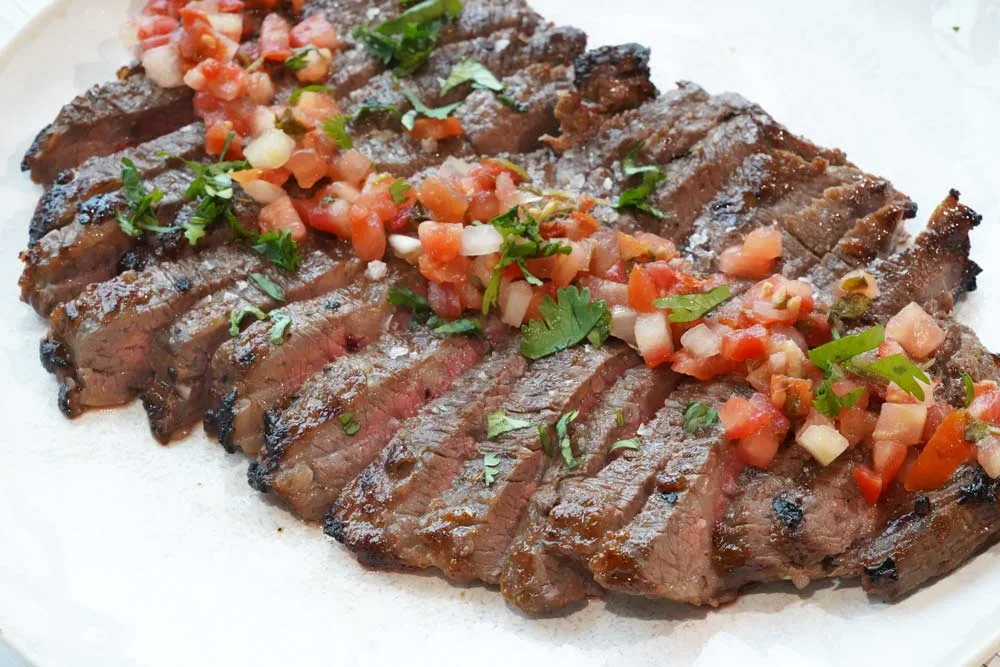
Cooking Time and Temperature: The Numbers That Actually Matter
Set the air fryer to 400°F (200°C). This temperature is the proven sweet spot for flank steak. It's hot enough to trigger the Maillard reaction efficiently and build a dark, flavorful crust, yet not so hot that the outside burns before the center reaches the target doneness.
For a steak that's approximately ¾ inch (1.9 cm) thick, cook for 4 to 6 minutes on the first side, then flip, and cook another 4 to 6 minutes on the second side. Total cook time is 8 to 12 minutes depending on actual thickness and your specific air fryer's wattage. Most standard countertop air fryers operate between 1400W and 1800W.
Lower-wattage models, particularly compact units under 5 quarts, may need an extra minute or two per side to achieve the same internal temperature and crust development.
If your air fryer has a dual basket design, which some newer 8 to 9 quart models feature, you'll want to ensure both pieces get equal airflow. Refer to our guide on best 8 Qt air fryers with dual baskets for models that handle this well, though note that a single flank steak doesn't necessarily require a dual-zone setup. A large-capacity single basket, like those found in the best 9 Qt air fryers for large batches, gives you plenty of room to cook the steak flat without cutting it.
| Steak Thickness | First Side | Second Side | Total Time (approx) | Target Internal Temp |
|---|---|---|---|---|
| ½ inch (1.3 cm) | 3 to 4 minutes | 3 to 4 minutes | 6 to 8 minutes | 130°F (54°C) to 135°F (57°C) |
| ¾ inch (1.9 cm) | 4 to 6 minutes | 4 to 6 minutes | 8 to 12 minutes | 130°F (54°C) to 135°F (57°C) |
| 1 inch (2.5 cm) | 5 to 7 minutes | 5 to 7 minutes | 10 to 14 minutes | 130°F (54°C) to 135°F (57°C) |
These times assume a properly preheated air fryer at 400°F and a steak that's been brought to room temperature. If your steak is going straight from the fridge to the basket, add 1 to 2 minutes per side, but always rely on the internal temperature rather than the clock. The USDA Food Safety and Inspection Service recommends a minimum internal temperature of 145°F (63°C) for whole cuts of beef with a 3-minute rest period.
However, flank steak, prized for its beefy flavor and lean texture, is widely preferred by chefs and home cooks at medium-rare (130°F to 135°F) for optimal tenderness. The choice is yours, but for flank steak specifically, pushing past medium is tempting toughness.
The Only Tool You Should Trust for Doneness
An instant-read meat thermometer is the single most important tool for executing any air fryer flank steak recipe perfectly. Every air fryer model runs slightly differently due to variations in basket design, heating element placement, airflow patterns, and wattage. Even altitude affects cook time at high elevations, just as it does when you're following any air fryer recipe for proteins like air fryer bratwurst or air fryer BBQ chicken legs.
The thermometer is the only reliable way to know what's happening inside the meat, period.
Insert the probe horizontally into the thickest part of the steak, from the side rather than the top. You want the tip of the probe centered in the middle of the meat, not touching the bottom of the basket or resting near the seared surface, both of which will give you a false reading. For medium-rare, pull the steak at 130°F (54°C).
For medium, pull at 135°F (57°C). The carryover temperature rise during the rest will add another 5 to 10 degrees on its own.
If you don't own a digital instant-read thermometer, this is the one kitchen tool that will improve not just your air fryer flank steak recipe but also every other protein you cook, from thick-cut pork chops to a holiday roast. This small investment eliminates guesswork entirely, which is why it consistently ranks among the most-recommended tools in professional test kitchens.
Letting It Rest and Slicing It Right
Why Resting Changes Everything
When you pull your air fryer flank steak out of the basket, the muscle fibers are tight and heavily contracted from the high heat. They've been squeezed, and if you cut into the steak at that exact moment, all the flavorful liquid inside will run directly onto the cutting board instead of staying in the meat where it belongs. This is a common mistake that separates amateur results from professional ones.
Letting the steak rest for 5 to 10 minutes gives the muscle fibers time to relax and reabsorb their juices. Tent the steak loosely with aluminum foil; the foil traps just enough heat to keep the steak warm while allowing excess steam to escape. Wrap it too tightly, and the trapped steam will soften the hard-earned crust you just built.
Think of this rest as an essential step in the same category as the sear itself, it's not optional.
How to Find the Grain and Slice Against It
Look at the surface of the cooked flank steak. You'll see distinct lines running in a single direction. Those lines are the muscle fibers, an easy visual to spot once you know what to look for, and collectively they define what butchers call the grain.
Position your sharp chef's knife perpendicular to those lines and slice the steak into thin strips, roughly ¼ inch (6 mm) thick. Cutting against the grain shortens each individual fiber into a tender, easy-to-chew piece, which is the entire secret to making flank steak feel tender rather than chewy.
Slicing on the bias, at roughly a 45-degree angle to the grain, creates wider, more visually appealing pieces that you'd typically see in a restaurant. This angled cut also increases the surface area of each slice, which makes every bite soak up whatever sauce or dressing you're serving alongside. A classic chimichurri, made from parsley, oregano, garlic, red wine vinegar, olive oil, and red pepper flakes, is the traditional accompaniment and contrasts beautifully with the beefy richness of the steak.
You can prepare the chimichurri while the steak rests; the two steps align perfectly. Even if your air fryer flank steak recipe is as simple as salt, pepper, and a squeeze of lime, slicing correctly elevates the entire experience.
What to Serve With Air Fryer Flank Steak
Flank steak is one of the most versatile proteins you can cook, and the air fryer makes it even easier to integrate into all kinds of meals throughout the week. Slice it thin and pile it into warm corn tortillas with pickled red onion, fresh cilantro, and a drizzle of crema for weeknight tacos that come together in minutes. Fan the slices over a bed of peppery arugula with shaved Parmesan and a splash of balsamic for a quick, elegant salad that feels restaurant-worthy.
Or build a balanced grain bowl with quinoa or cilantro-lime rice, black beans, avocado, and a spoonful of salsa verde, a combination that holds up beautifully in a lunchbox.
For a heartier spread alongside your air fryer flank steak, roasted sweet potatoes, grilled corn on the cob, and a side of seasoned black beans round out the plate without requiring much extra effort. If you're actively meal prepping, store the sliced steak in a separate airtight container from the sides; this prevents the meat from getting soggy and lets you reheat each component independently without accidentally overcooking the steak a second time. For guidance on choosing the right air fryer for high-heat proteins at scale, check out our reviews of the Instant Vortex air fryer to see how its cooking performance compares.
Common Mistakes That Ruin Air Fryer Flank Steak
Even a well-written air fryer flank steak recipe can fail if basic technique is overlooked. Here are the mistakes we see most often, and how to avoid each one:
- Skipping the preheat. A cold basket means the steak starts cooking in a constantly rising temperature environment. You lose the immediate, high-heat sear that locks in flavor and creates a crust. Always preheat your air fryer for a full 3 to 5 minutes before adding the meat.
- Overcrowding the basket. If the steak doesn't lie flat without overlapping, cut it in half. Overlapping pieces block the airflow and create steamed, gray patches instead of an evenly browned crust. Air fryer cooking depends entirely on unobstructed air circulation.
- Not blotting the steak dry. A wet surface prevents browning and results in an unappealing gray exterior. This is basic food science: the Maillard reaction requires direct contact between dry, high-heat surfaces and the meat's surface. Pat it fully dry before seasoning.
- Cooking straight from the fridge. A dramatically cold center takes much longer to cook through, which means the outside inevitably overcasses before the inside catches up. Letting the steak sit at room temperature for just 20 to 30 minutes corrects this.
- Slicing with the grain instead of against it. This one mistake can turn a perfectly cooked flank steak into a chewy, stringy mess in seconds. Always take an extra five seconds to visually identify the grain and cut perpendicular to it, or at a 45-degree bias for the best presentation.
- Skipping the thermometer and guessing. Guessing doneness by time alone is the fastest path to overcooked flank steak. Every air fryer wattage and model performs differently. An instant-read thermometer is the only reliable way to hit your target doneness, and models like the Instant Vortex air fryer are no exception, the thermometer is mandatory regardless of the appliance. If you're upgrading to a model with smart controls, our roundup of the best 8 Qt air fryers with smart controls offers excellent options that make precision cooking even easier.
Air Fryer Flank Steak vs. Other Cooking Methods
No single cooking method is the best in every situation, and understanding how the air fryer compares to other popular techniques for flank steak will help you choose the right approach for any given night. Each method has distinct trade-offs in flavor, convenience, texture, and cleanup.
Air Fryer vs. Cast Iron Skillet
A preheated cast iron skillet produces the deepest, darkest, most heavily caramelized sear of any indoor method, thanks to cast iron's exceptional heat retention and direct metal-to-meat contact. However, it comes with notable trade-offs: more oil is required to prevent sticking, splatter across the stovetop can be significant, and the smoke produced by searing at high heat in an open pan often triggers home ventilation alarms. Cleanup involves handling a heavy, oil-coated pan.
The air fryer produces a lighter but still impressive browned crust with minimal oil and almost no splatter. The circulating hot air reaches all sides of the steak simultaneously, and the enclosed cooking chamber contains the mess. For a weeknight air fryer flank steak recipe when convenience and cleanup speed are priorities, the air fryer consistently wins on practicality.
For sheer maximum crust depth in a competition-style steak, cast iron still holds a slight edge.
Air Fryer vs. Outdoor Grill
Nothing fully replicates the flavor profile imparted by an open charcoal or gas flame. Grilling produces a distinctive smoky char and flavor compounds that no other method can precisely duplicate. However, grilling demands setup time, consistent grate cleaning, and favorable weather conditions.
It also requires active attention to manage flare-ups, adjust for hot spots across the grate, and flip at precisely the right time.
The air fryer delivers a remarkably consistent result with zero outdoor setup, no weather dependence, and minimal hands-on attention once the steak is in the basket. It won't taste exactly like a grilled steak, but on the crust development front, it gets surprisingly close. For apartment dwellers without balcony access, or anyone who wants a solid flank steak without the hassle, an air fryer flank steak recipe is a thoroughly practical alternative.
Air Fryer vs. Oven Broiler
The broiler is the closest oven-based comparison to the air fryer. It applies intense radiant heat from directly above, which can produce a good crust. However, most residential broilers heat unevenly, often leaving one side of the steak noticeably more cooked than the other, and they require you to position the rack at a specific distance from the element, which takes trial and error.
An air fryer circulates heat evenly from all directions using its convection fan, resulting in more uniform browning on all surfaces without the need to reposition or rotate the meat. Preheat time is also significantly shorter: 3 to 5 minutes for an air fryer, versus 10 to 15 minutes for an oven broiler. For flank steak specifically, the air fryer outperforms the broiler in almost every practical category, from crust evenness to speed to cleanup.
Quick Marinade and Dry Rub Recipes for Air Fryer Flank Steak
Having a few reliable seasoning options on hand makes it easy to execute any air fryer flank steak recipe without a trip to the store. Here are three proven combinations that work beautifully with the high-heat, fast-cook environment of the air fryer:
- Soy-Lime Marinade. Combine ¼ cup soy sauce, juice of 2 limes, 2 tablespoons olive oil, 3 minced garlic cloves, 1 tablespoon brown sugar, and ½ teaspoon freshly ground black pepper. Marinate the steak for 2 to 8 hours in the refrigerator. This marinade delivers a savory, tangy flavor with a subtle sweetness that plays nicely against the beef's natural richness. Perfect for tacos or grain bowls.
- Smoky Chipotle Marinade. Blend 2 chipotle peppers in adobo sauce, 3 tablespoons olive oil, juice of 1 lime, 1 tablespoon honey, 2 minced garlic cloves, and ½ teaspoon ground cumin. Marinate the steak for 2 to 6 hours. This version is spicier and bolder, ideal for fajitas or served alongside roasted sweet potatoes. Rinse your hands thoroughly after handling the peppers.
- All-Purpose Smoky Dry Rub. Mix 1 tablespoon kosher salt, 1 teaspoon freshly ground black pepper, 1 teaspoon garlic powder, 1 teaspoon smoked paprika, ½ teaspoon ground cumin, and ½ teaspoon chili powder. Apply generously to the surface of a dry steak at least 20 minutes before cooking. If you have time, let it sit uncovered in the fridge for up to 4 hours; the salt will draw in and redistribute for deeper flavor penetration. No marinade needed, and the result is a beautifully spiced, crusty exterior.
Storing and Reheating Cooked Flank Steak
A properly executed air fryer flank steak recipe often yields leftovers, and handling them correctly is the difference between a delicious next-day lunch and a dry, sad imitation of the original meal. Store the fully cooled, sliced steak in an airtight glass or BPA-free plastic container in the refrigerator. It keeps well for 3 to 4 days.
Adding a tablespoon of low-sodium beef broth or a squeeze of fresh lime juice to the container before sealing helps prevent the lean meat from drying out during storage.
When reheating, gentle heat is your friend. A microwave on medium (50 percent) power in 30-second intervals works in a pinch, but a far better method is a quick 30-second-per-side sear in a hot, lightly oiled skillet. This re-crisps the exterior without pushing the internal temperature high enough to overcook the meat a second time.
Avoid blasting it in the air fryer again, the intense heat will push it past your original target doneness in under 2 minutes.
For meal prep purposes, cook the steak using your preferred air fryer flank steak recipe, let it rest fully, slice it against the grain, and portion it into individual containers with complementary sides like rice, black beans, or roasted vegetables. This approach gives you grab-and-go lunches that taste freshly made, and it's one of the most efficient ways to get multiple dinners or lunches out of a single cooking session. If you're considering a larger air fryer to streamline this kind of batch cooking, our guide to the best 9 quart air fryers for big families covers models with the capacity to handle multiple steaks at once.
Frequently Asked Questions
Can I cook frozen flank steak in an air fryer?
Yes, you can cook frozen flank steak directly in the air fryer without thawing. Add 4 to 6 minutes to the total cook time compared to a thawed steak. Pat the surface dry after the first flip to remove any moisture released during the initial thaw in the basket.
The internal temperature remains your most reliable guide to doneness. For the best texture and most even cooking, thawing the steak in the refrigerator overnight before starting your air fryer flank steak recipe is still the preferred approach.
Do I need to flip the steak halfway through cooking?
Yes. Flipping once at the midpoint of the total cook time ensures even browning on both sides. Air fryers circulate heat primarily from the element above the basket, but the bottom surface benefits from direct contact with the basket grate, which creates grill-mark-style browning.
One flip is all you need; repeatedly opening the basket to check or re-flip causes heat loss and extends the total cook time.
What temperature should I set the air fryer to for flank steak?
400°F (200°C) is the standard recommended temperature for most air fryer flank steak recipes. It is hot enough to build a flavorful crust through the Maillard reaction while keeping the center tender and pink. Some experienced users prefer starting at 375°F (190°C) for the first half with thicker cuts (1 inch or more) and then increasing to 400°F for the final few minutes to develop the crust.
However, 400°F throughout the cook works reliably for the majority of home setups.
How do I know when flank steak is done without a thermometer?
The finger-press test is the only reliable rough alternative to a thermometer. Touch the fleshy pad at the base of your thumb while pressing your thumb to your middle finger; the resistance you feel approximates the firmness of a medium-rare steak. However, this method is imprecise and varies from person to person.
An instant-read digital thermometer is far more reliable and is a worthwhile investment for anyone who cooks steak regularly, whether in an air fryer, on a grill, or in a cast iron skillet.
Can I marinate flank steak overnight?
Yes, marinating for 8 to 12 hours in the refrigerator works well and produces deeply flavored meat. Avoid exceeding 12 hours when using highly acidic marinades (those heavy in citrus juice, vinegar, or wine), as the acid will begin breaking down surface proteins and create a mushy texture. If you want to marinate longer for flavor development, use a oil-based or soy sauce-based marinade with lower acid content, or switch to a dry rub applied before cooking.
Why is my air fryer flank steak producing smoke?
Flank steak is very lean, but any fat or marinade residue that drips onto the heating element during cooking can produce smoke. Make sure the air fryer basket and the interior are clean before you start cooking. Use a high-smoke-point oil like avocado oil (520°F / 271°C) rather than extra-virgin olive oil (around 375°F / 190°C), which burns at air fryer temperatures.
If your air fryer has a grease collection tray beneath the heating element, check that it is not full from previous use. Running your kitchen range hood or opening a window during cooking also helps manage any minor smoke.