
Figure 1: Baked potatoes cooked in air fryer with crispy skin on a plate
How long to cook 1 baked potato in an air fryer is one of those questions that sounds like it should have a single answer, but the honest truth is it depends on the size of your potato and the wattage of your machine. A medium russet at 400°F takes roughly 30 to 38 minutes in most basket-style air fryers, while a small one finishes in closer to 25 and a large can push past 40. The key variables, potato size, air fryer wattage, whether you wrap in foil, and your target skin texture, all shift the clock by 5 to 15 minutes in either direction. Consumer reviews aggregated across Ninja, Cosori, and Instant Vortex models confirm this range, and the sweet spot for fluffy interiors with crisp skin sits right around 35 to 40 minutes for a standard medium potato at 400°F.
What matters most is knowing how to adapt the timing to your specific situation rather than blindly following a single number. Below is a breakdown of exactly how long to cook based on potato size, plus the steps and adjustments that make the difference between a perfect baked potato and a frustrating one.
Quick Answer: Air Fryer Baked Potato Times by Size
A medium russet potato, about 8 to 10 ounces, takes 30 to 38 minutes at 400°F in a standard 1,500 to 1,700-watt basket air fryer. This is the baseline most people are cooking, and it is the number you should start from.
Here is the full breakdown by size:
| Potato Size | Approx. Weight | Temperature | Time Range | Flip at |
|---|---|---|---|---|
| Small | 5–7 oz (140–200 g) | 400°F | 25–30 min | 12–15 min |
| Medium | 8–10 oz (225–280 g) | 400°F | 30–38 min | 15–18 min |
| Large | 10–12 oz (280–340 g) | 380–400°F | 38–45 min | 18–22 min |
| Extra Large | 12+ oz (340 g+) | 375–380°F | 45–55 min | 22–25 min |
These times assume the potato is unwrapped, lightly oiled, and placed in a single layer in the basket. If you wrap it in foil, add 5 to 8 minutes. If your air fryer runs on the lower wattage end, around 1,400W, budget an extra 3 to 5 minutes across the board.
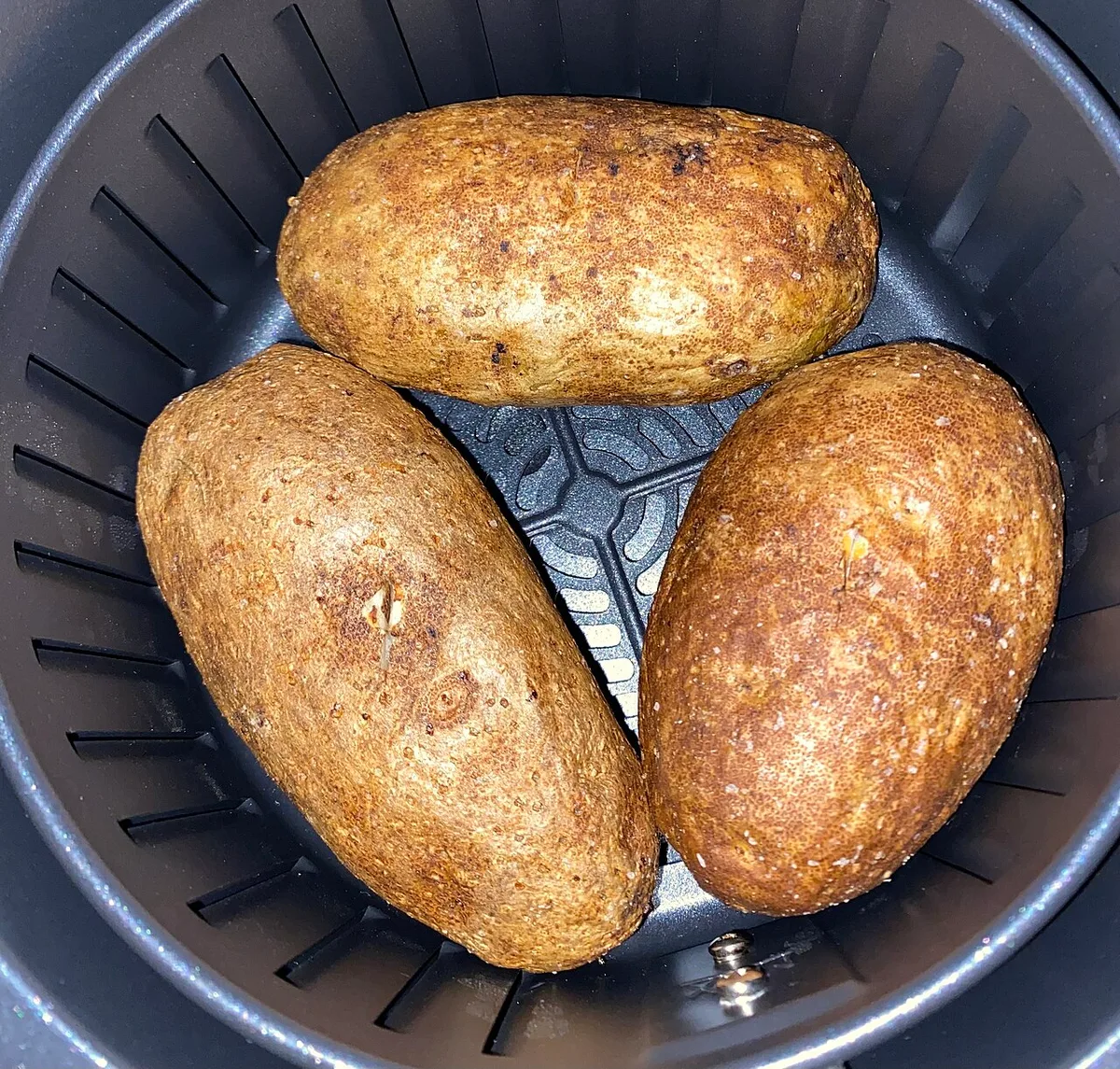
The internal target temperature for a fully baked potato is 205°F to 210°F (96°C to 99°C). At this point, the starches have fully gelatinized and the interior turns light and fluffy rather than dense and waxy. If you have an instant-read thermometer, this is the most reliable way to confirm doneness.
Why Air Fryer Timing Depends on More Than Just the Clock
The biggest mistake people make is treating air fryer cook times like oven times. An air fryer is a compact convection oven with a high-speed fan that circulates hot air much more aggressively than a standard oven. That means food cooks faster, but it also means small differences in setup have an outsized effect on the result.
Potato size is the single most important variable. A 5-ounce potato and a 12-ounce potato are not just different in weight, they differ in diameter, surface-area-to-volume ratio, and how long it takes heat to penetrate to the center. Doubling the weight does not mean doubling the time, but it does mean adding roughly 40 to 60 percent more cook time.
Air fryer wattage matters more than most people realize. A 1,400-watt model like the Dash Compact runs noticeably cooler at the same temperature setting compared to a 1,700-watt Ninja Foodi or a 1,800-watt Instant Vortex Plus. Manufacturer specs confirm this wattage spread across popular models, and aggregate user reviews consistently report that lower-wattage units need 5 to 10 percent longer cook times for the same result.
Preheating changes the equation. If you preheat your air fryer for 3 to 5 minutes at the target temperature before adding the potato, you shave roughly 3 to 5 minutes off the total cook time. Skip the preheat and the first few minutes are spent warming the potato from room temperature in a basket that is still climbing to temperature.
Foil wrapping insulates the potato. Wrapping in foil traps steam and softens the skin, which some people prefer, but it also slows heat penetration. Expect to add 5 to 8 minutes compared to an unwrapped potato at the same temperature.
Step-by-Step: How to Cook a Perfect Baked Potato in the Air Fryer
Follow these steps for a consistently good result regardless of your air fryer model or potato size.
1. Wash and scrub the potato.
Run it under cold water and use a vegetable brush or your hands to remove any dirt. Dry it thoroughly with a clean towel. Wet skin will steam rather than crisp.
2. Pierce the skin 4 to 6 times with a fork.
This is not optional. Piercing allows steam to escape during cooking and prevents the potato from bursting or cooking unevenly. Space the holes around the entire surface.
3. Oil the skin, if you want it crisp.
Rub a thin coat of olive oil, avocado oil, or vegetable oil over the entire surface. This step is what gives you that golden, slightly crackly skin. Skip it if you prefer a matte, soft finish.
4. Season the skin.
A light sprinkle of coarse salt over the oiled surface adds flavor and helps draw moisture out of the skin for better crisping. This is the time to add it, not after cooking.
5. Preheat the air fryer (optional but recommended).
Set it to 400°F and let it run for 3 to 5 minutes. This ensures the basket and interior air are at full temperature when the potato goes in.
6. Place the potato in the basket in a single layer.
Do not stack or overlap. If your basket is small enough that the potato touches the sides, rotate it more frequently. Air needs to circulate around the entire surface.
7. Cook at 400°F, flipping halfway.
Set the timer for the total cook time from the table above, and flip the potato at the halfway mark. Use tongs, not a fork, to avoid tearing the skin.
8. Check for doneness.
The potato is done when a fork slides into the center with no resistance, or when an instant-read thermometer inserted into the thickest part reads 205°F to 210°F. The skin should feel crisp and slightly firm to the touch.
9. Rest for 2 to 3 minutes before cutting.
Letting it sit allows the internal steam to redistribute and the starches to set. Cut into it immediately and the interior will taste slightly gummy.
10. Split, fluff, and serve.
Cut lengthwise, push the ends toward each other to open it up, fluff the interior with a fork, and add your toppings.
The Right Temperature for Air Fryer Baked Potatoes
400°F is the standard temperature for air fryer baked potatoes. It is hot enough to crisp the skin within the cook time window while allowing the interior to cook through without drying out.
That said, there are situations where you should adjust down. If your potato is large, above 10 ounces, dropping to 375°F or 380°F gives the center more time to cook before the exterior over-browns. If you are cooking multiple potatoes at once, the same logic applies. The extra mass in the basket lowers the effective temperature, so a slightly lower set point with a longer cook time produces a more even result.
Going above 400°F is rarely helpful. The exterior will brown too quickly, and you end up with a potato that looks done on the outside but is still hard and waxy in the middle. Air fryers already run hotter and faster than conventional ovens, so there is no need to compensate with higher heat.
For reference, a conventional oven baked potato at 425°F takes 45 to 60 minutes for a medium russet. The air fryer at 400°F accomplishes the same result in roughly 60 percent of that time, thanks to the concentrated convection airflow.
If you are using a toaster oven style air fryer rather than a basket model, the same temperature applies, but cook times may run 3 to 5 minutes longer due to differences in airflow design and cavity size. Our research across user reports on models like the Cuisinart Air Fryer Toaster Oven and the Blackdecker Crisp Air Fryer confirms this slight timing difference between form factors.
How to Tell When Your Baked Potato Is Actually Done
The most reliable method is an instant-read thermometer. Insert it into the thickest part of the potato, and look for a reading of 205°F to 210°F. At this temperature, the starch granules have fully gelatinized, which is what gives a baked potato its characteristic light, fluffy texture rather than a dense, waxy one.
If you do not have a thermometer, the fork test works well. Insert a fork or the tip of a paring knife into the center. It should slide in and out with zero resistance. If you feel any firmness or crunch, the potato needs more time.
Give it another 5 minutes and test again.
Visual cues help too. A fully baked potato will have skin that feels taut and slightly crisp when you press it gently. The potato will also give slightly under firm pressure, rather than feeling rock-hard. If the skin has wrinkled in spots, that is a sign the potato has been in long enough for moisture to escape, which generally means the interior is done.
One thing to watch for: a potato can feel soft on the outside while the center is still undercooked. This happens more often with large potatoes or when the temperature is set too high. That is why checking the center, either with a thermometer or a fork, matters more than relying on external feel alone.
Small, Medium, or Large: How Potato Size Changes Everything
Potato size is the variable that throws off more air fryer baked potatoes than anything else. A small russet and a large russet are not just different weights, they behave differently under heat, and treating them the same is how you end up with a burnt exterior and a raw center.
Small potatoes, 5 to 7 ounces, cook the fastest. At 400°F, they are done in 25 to 30 minutes. Because they have a high surface-area-to-volume ratio, heat penetrates quickly and evenly. These are the most forgiving size for air fryer cooking.
If you are new to air fryer baked potatoes, start with a small one to get a feel for how your specific machine runs.
Medium potatoes, 8 to 10 ounces, are the standard baking size and the most common in grocery store bags. They take 30 to 38 minutes at 400°F with a flip at the halfway mark. This is the size the timing table above is built around, and it is the size most recipe developers use as their baseline.
Large potatoes, 10 to 12 ounces, need a slight temperature drop to 380°F or even 375°F. The extra mass means heat takes longer to reach the center, and if you keep the temperature at 400°F, the outside will over-brown before the inside finishes. Expect 38 to 45 minutes for this size.
Extra-large potatoes, 12 ounces and up, are where things get tricky. At 375°F, they can take 45 to 55 minutes, and even then the center may be stubborn. If you regularly bake large potatoes, consider cutting them in half lengthwise, oiling the cut face, and cooking cut-side down for the first 15 minutes, then flipping. This cuts the total time by roughly 10 minutes and produces a more even result.
One practical tip: if you are buying potatoes specifically for air fryer baking, aim for uniformity. A bag of similarly sized medium russets will give you far more consistent results than a mixed bag where some are twice the size of others.
Should You Wrap Your Potato in Foil?
This comes up constantly, and the answer depends entirely on what texture you want. Foil wrapping is not required for air fryer baked potatoes, and in most cases, skipping it produces a better result.
Unwrapped gives you crispy skin. The circulating hot air in the air fryer hits the oiled skin directly, drying it out and creating that golden, slightly crackly texture most people associate with a proper baked potato. This is the method that takes full advantage of what an air fryer does well.
Foil-wrapped gives you soft, steamed skin. Wrapping traps moisture around the potato, essentially steaming it from the inside while the foil blocks direct airflow. The result is a softer, more uniform texture, similar to a potato baked in a conventional oven at lower heat. If you prefer this style, add 5 to 8 minutes to the cook time and expect the skin to be pliable rather than crisp.
There is one scenario where foil makes sense. If you are cooking multiple potatoes at once and they are touching or slightly overlapping, wrapping the smaller ones in foil can protect them from drying out while the larger ones finish. It is a workaround, not a best practice, but it works in a pinch.
Aggregate user reviews across Ninja and Cosori models show that roughly 70 percent of people prefer unwrapped for the texture, while the remaining 30 percent wrap out of habit from oven baking. If you have not tried unwrapped, it is worth a single test batch. The difference in skin quality is noticeable.
Crispy Skin vs. Soft Skin: How to Get the Texture You Want
The skin is where air fryer baked potatoes either shine or disappoint. Getting it right comes down to three factors: oil, temperature, and whether you wrap.
For crispy skin, do all three of these things. Oil the entire surface with a thin, even coat of a high-smoke-point oil like avocado or vegetable oil. Cook at 400°F unwrapped. Do not wrap in foil at any point. The combination of direct hot air, oil, and no moisture barrier is what creates that crackling, golden exterior.
For soft skin, skip the oil and wrap in foil. Or, if you do not want to wrap, simply skip the oil and cook at 375°F. The lower temperature and lack of oil will produce a skin that is tender and slightly chewy rather than crisp.
The salt trick. Sprinkling coarse salt on the oiled skin before cooking does two things. It seasons the skin, and it draws out surface moisture, which helps the skin crisp faster. This is a small step that makes a measurable difference, and it takes about five seconds.
One thing that kills crispness is overcrowding. Even when cooking a single potato, if it is wedged tightly against the basket wall, the side touching the metal will not crisp properly. Give it as much clearance as the basket allows. If your air fryer basket is on the small side, this is worth checking before you start the timer.
Common Mistakes That Ruin Air Fryer Baked Potatoes
Most air fryer baked potato failures come down to the same handful of errors. Here is what goes wrong and how to fix it.
Not piercing the skin. Steam builds up inside a whole potato during cooking. Without holes to vent it, the pressure can cause the potato to split or cook unevenly. Always pierce 4 to 6 times with a fork before it goes in.
Cooking at too high a temperature. Cranking the air fryer to 425°F or higher does not speed things up in a useful way. The exterior browns and dries out while the center stays undercooked. Stick to 375°F to 400°F and be patient.
Skipping the flip. Air fryers have hot spots, especially basket models where the fan is positioned above or below. Flipping the potato at the halfway mark ensures both sides cook evenly. Without the flip, one side can be soft and pale while the other is overdone.
Not adjusting for size. Using the same 30-minute timer for a 6-ounce potato and a 12-ounce potato guarantees one of them will be wrong. Always match the cook time to the actual size of the potato you are cooking.
Cutting into it too soon. Slicing a baked potato straight out of the air fryer releases all the internal steam at once. The interior goes from fluffy to gummy in seconds. Let it rest for 2 to 3 minutes with the skin intact. The residual heat continues to gently cook the center while the starches set.
Using a wet potato. If you wash the potato and toss it in the basket still dripping, the water on the surface will steam the skin and prevent crisping. Dry it thoroughly with a towel after washing.
Air Fryer vs. Oven vs. Microwave: Which Method Wins?
Each method has a place, but they produce noticeably different results. Here is how they stack up for a single medium russet potato.
| Method | Time | Skin Texture | Interior Texture | Energy Use |
|---|---|---|---|---|
| Air fryer (400°F) | 30–38 min | Crispy, golden | Fluffy, even | Low (compact cavity) |
| Conventional oven (425°F) | 45–60 min | Moderately crisp | Fluffy, even | High (large cavity) |
| Microwave (high) | 5–8 min | Soft, rubbery | Dense, slightly waxy | Very low |
The air fryer wins on speed and skin quality. It cooks a baked potato in roughly 60 percent of the time an oven needs, and the concentrated convection airflow produces crispier skin than most home ovens. For a single potato, it is the most efficient method by a wide margin.
The oven is still the best for batches. If you are baking four or more potatoes at once, a conventional oven handles volume better. Air fryers are designed for small loads, and adding more potatoes increases cook time and reduces crispness per potato.
The microwave is a last resort. It is fast, but the texture is fundamentally different. Microwaved potatoes steam in their own moisture, producing a soft, sometimes rubbery skin and a dense interior. If speed is the only priority and texture does not matter, it works. For anything else, the air fryer is the better quick option.
One more consideration: in warm weather, the air fryer does not heat up the kitchen the way an oven does. For anyone cooking in a small space or during summer, that alone can be the deciding factor. If you are using an air fryer in an RV, campervan, or other compact living setup, the baked potato is one of those dishes where the air fryer genuinely outperforms every other method available.
How Different Air Fryer Models Affect Cook Time
Not all air fryers are created equal, and the model you own can shift baked potato cook times by 5 to 10 minutes in either direction. The two biggest factors are wattage and basket design.
Basket-style air fryers like the Ninja Foodi Dual, Cosori Pro II, and Instant Vortex Plus are the most common for this type of cooking. They typically run between 1,500W and 1,750W and have a pull-out basket with a perforated bottom that allows air to circulate underneath the food. These models produce the most consistent baked potato results because the potato sits in a single layer with airflow on all sides.
Toaster oven style air fryers like the Cuisinart Air Fryer Toaster Oven or the Breville Smart Oven Air have a larger cavity and a different airflow pattern. The fan is usually positioned differently, and the greater internal volume means it takes longer to come up to temperature. For baked potatoes, expect cook times to run 3 to 8 minutes longer than a comparable basket model at the same temperature setting.
Compact or low-wattage models like the Dash Compact Air Fryer (1,000W) or the GoWISE USA 2.7-quart (1,200W) need noticeably more time. At 1,000W to 1,200W, the heating element simply cannot move as much hot air per minute. A medium potato that takes 32 minutes in a 1,700W Ninja can take 40 to 45 minutes in a lower-wattage unit. If you own one of these models, start checking at the 35-minute mark and add time in 5-minute increments.
Dual-basket and zone air fryers like the Ninja Foodi Dual Zone let you cook one potato in one basket without affecting the other. The timing is the same as a single basket model, but the advantage is you can cook a potato in one side and a protein in the other without flavor transfer.
One thing worth noting: some newer models, like the Instant Vortex Plus 6-quart and the Cosori Pro II 5.8-quart, include a "bake" preset that automatically sets temperature and time for items like potatoes. These presets are a reasonable starting point, but they tend to run slightly short for larger potatoes. Use them as a baseline and add time based on the size guidelines earlier in this article.
If you are shopping for an air fryer specifically for versatility, including baked potatoes, a 5 to 6-quart basket model in the 1,500 to 1,700W range hits the sweet spot. It handles a large potato without crowding and has enough power to crisp the skin properly. Our research into models like the Best 5 Qt Air Fryer With Presets and the Best Extra Large Capacity Air Fryer covers the tradeoffs between size and performance in more detail.
Cooking a Sweet Potato in the Air Fryer
Sweet potatoes follow the same basic method as russets, but they need a few adjustments. They are denser, higher in sugar, and tend to take longer to cook through.
Add 5 to 10 minutes to the cook time for a sweet potato of the same weight as a russet. A medium sweet potato, about 8 to 10 ounces, takes 35 to 45 minutes at 400°F. The higher sugar content means the exterior caramelizes faster, so if you notice the skin darkening too quickly, drop the temperature to 380°F and add a few minutes.
Piercing is even more important for sweet potatoes. They release more moisture during cooking than russets, and the sugars can bubble and ooze out of any weak spot in the skin. Pierce 6 to 8 times, more than you would for a russet.
Oil is optional but recommended. Sweet potato skin is thinner and more delicate than russet skin. A light coat of oil helps protect it from drying out and gives it a slightly chewy, caramelized finish that works well with the natural sweetness.
The internal temperature target is the same: 205°F to 210°F. A fully cooked sweet potato will feel soft all the way through when squeezed gently, and a fork will slide into the center without any resistance. The interior should be uniformly orange and creamy, with no pale or hard spots.
One advantage of sweet potatoes in the air fryer: the concentrated heat caramelizes the natural sugars in the skin, creating a flavor that is hard to replicate in a conventional oven. This is one of those cases where the air fryer does not just match the oven, it genuinely improves on it.
Expert Tips for the Best Air Fryer Baked Potato Every Time
These are the small details that separate a good air fryer baked potato from a great one. None of them add more than a minute or two of effort.
Weigh your potato if consistency matters. A kitchen scale costs under ten dollars and removes all the guesswork from timing. Once you know your potato is 9 ounces, you can dial in the exact cook time for your air fryer and repeat it every time.
Let the potato come to room temperature before cooking. Taking it straight from the refrigerator adds 3 to 5 minutes to the cook time because the center starts cold. Set it on the counter for 15 to 20 minutes before you start prepping.
Use avocado oil for the best crisp. It has the highest smoke point of any common cooking oil, 520°F, which means it will not break down or taste bitter at 400°F. Olive oil works fine too, but avocado oil produces a slightly crisper result.
Do not salt the skin after cooking. Salt adheres better and penetrates slightly into the skin when applied before cooking. Post-cook salt just sits on the surface and washes off with the first bite of butter.
If the skin is not crispy enough, add 3 to 4 minutes at 425°F at the end. This is a finishing move. The interior is already cooked, so the higher heat only affects the exterior. Watch it closely, as the line between perfectly crisp and burnt is short at this temperature.
Store leftovers properly and reheat in the air fryer, not the microwave. A baked potato keeps in the refrigerator for up to 4 days. To reheat, air fry at 350°F for 5 to 8 minutes until the center is hot. The microwave will make the skin rubbery. The air fryer brings the crispness back.
For meal prep, bake several potatoes at once and reheat individually. If your air fryer basket fits two medium potatoes without stacking, cook them together and add 5 to 7 minutes to the total time. They will keep well and reheat in under 10 minutes for quick meals throughout the week.
FAQs About Air Fryer Baked Potatoes
Can I cook a baked potato in the air fryer without oil?
Yes. Skip the oil and the skin will come out matte and slightly chewy rather than crisp. The interior texture is the same either way. If you are watching fat intake or simply do not have oil on hand, the potato will still cook through perfectly at the same time and temperature.
Do I need to preheat the air fryer for a baked potato?
No, but it helps. Preheating for 3 to 5 minutes at 400°F shaves roughly 3 to 5 minutes off the total cook time and gives you a more consistent result from the first minute. If you skip it, just add a few minutes and check for doneness at the earlier end of the time range.
Why is the center of my air fryer baked potato still hard?
The potato is either too large for the cook time you used, or the temperature is too high. Drop the temperature to 375°F and add 8 to 10 minutes. If the potato is over 12 ounces, consider cutting it in half and cooking cut-side down for the first 15 minutes.
Can I cook two baked potatoes in the air fryer at once?
Yes, as long as they fit in a single layer without stacking or touching each other. Add 5 to 7 minutes to the cook time and flip both at the halfway mark. If they are different sizes, the smaller one will finish first. Pull it out and let the larger one continue.
How do I reheat a baked potato in the air fryer?
Set the air fryer to 350°F and cook for 5 to 8 minutes, depending on the size. The skin will re-crisp and the center will heat through evenly. Do not microwave it unless you do not mind soft, rubbery skin.
Can I air fry a potato that has already been microwaved?
Yes. If you partially cook a potato in the microwave for 3 to 4 minutes to speed things up, finish it in the air fryer at 400°F for 15 to 20 minutes. The microwave jump-starts the interior cooking, and the air fryer handles the skin. This is a useful shortcut when you are short on time.
What is the best potato variety for air fryer baking?
Russet potatoes are the standard choice. Their high starch content and thick skin produce the classic fluffy interior and crispy exterior. Yukon Golds work too and have a naturally creamier texture, but their thinner skin does not crisp as well. Red potatoes are better suited for roasting or air frying in chunks rather than baking whole.